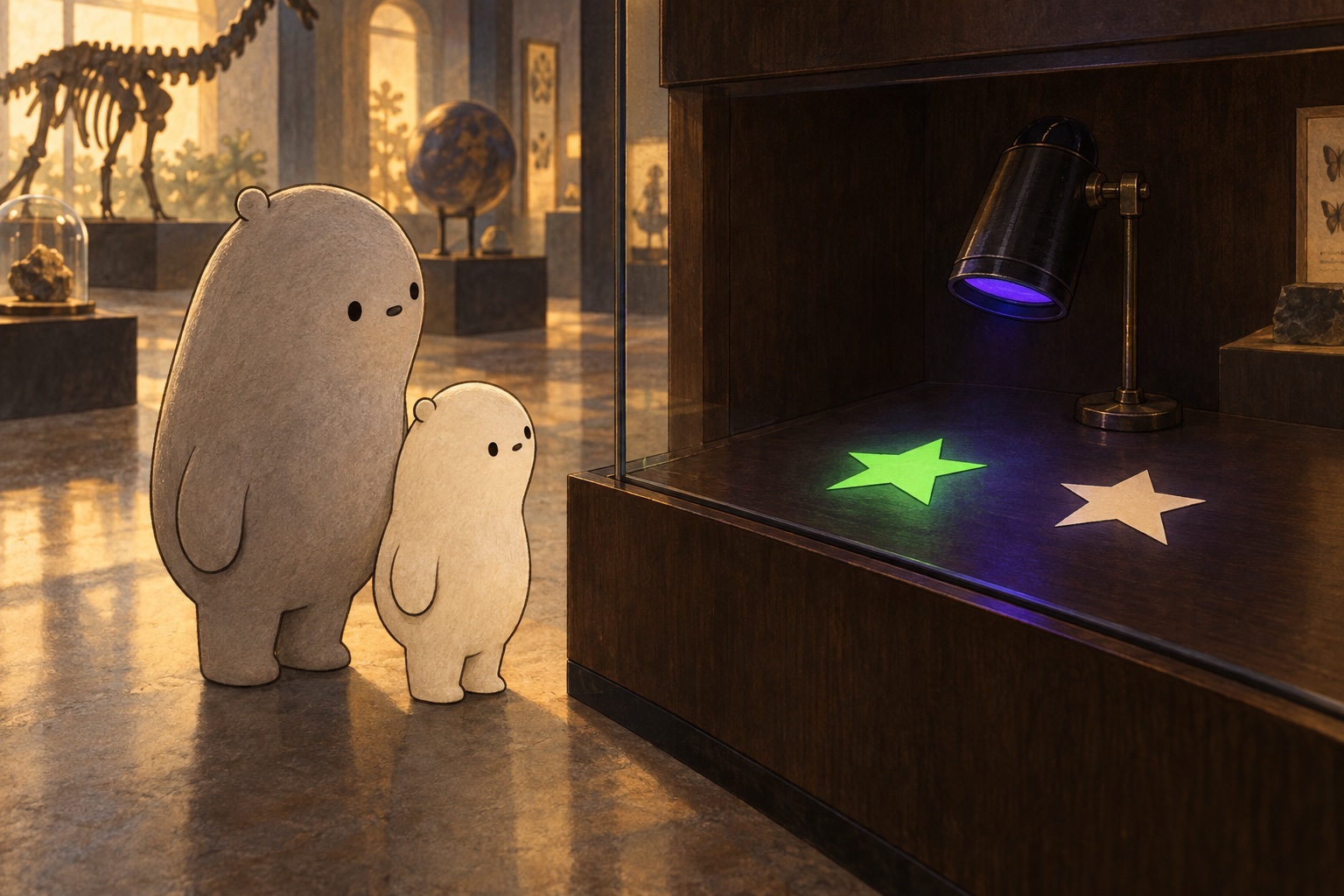
The stars have different coatings; their shared shape does not explain the glow.
Why does only one star glow?
Find the two paper stars. What looks the same? What looks different? Keep a guess before opening the explanation.
A little explanation & something to try
The glowing star has a fluorescent coating. It takes in light from the black light and gives out green light we can see. The other star has no coating that makes a noticeable glow in this model. Shape alone does not decide which object glows.
Try this. Point to the part you would change to test your guess in a drawing: the lamp, the star's shape, or its material.
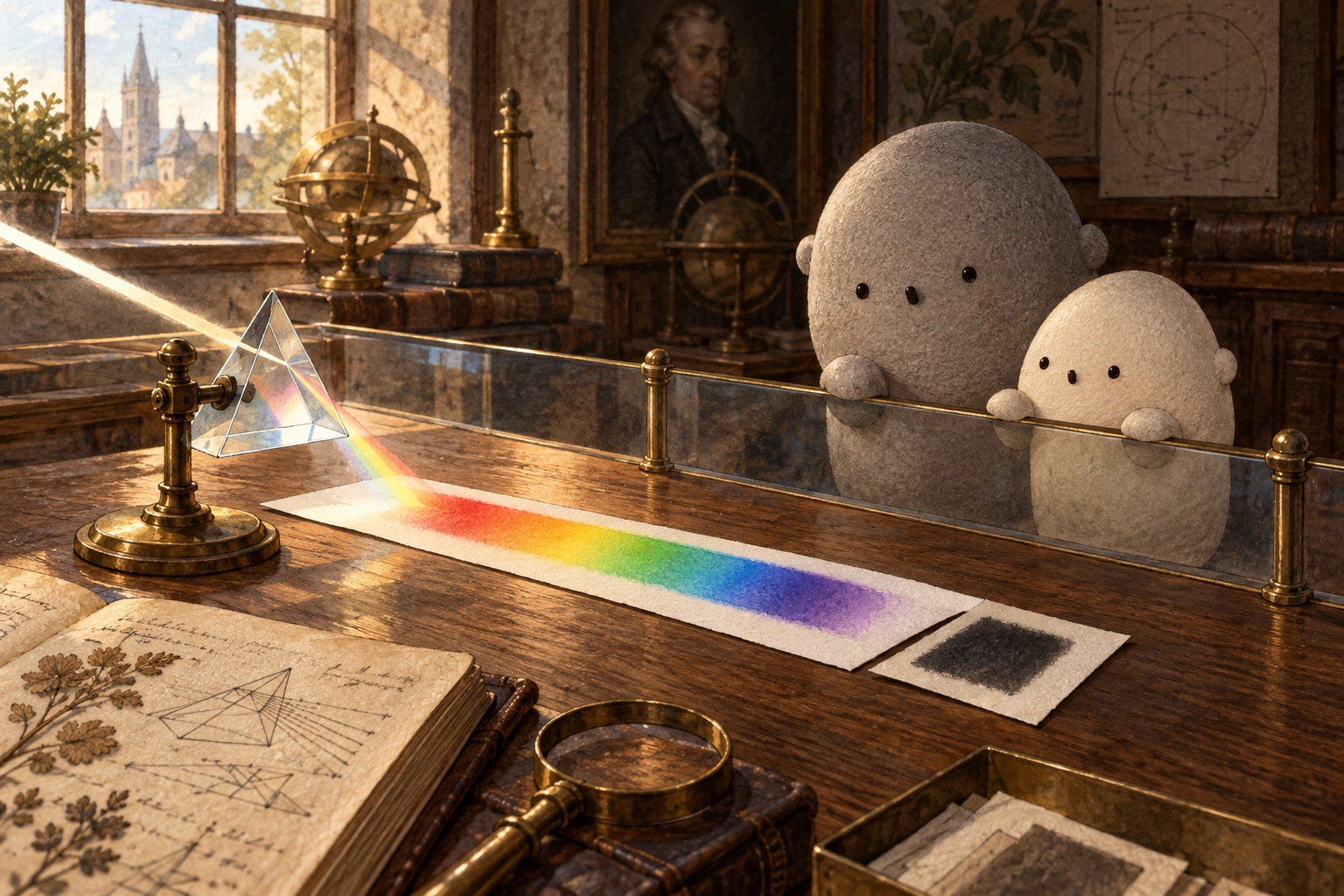
The dark sample is a clue to unseen UV.
Can light reach a place our eyes cannot see?
Follow the rainbow to its violet end. The small dark patch sits just beyond it. What might a change in the paper tell us?
A little explanation & something to try
In 1801, Johann Ritter found that light-sensitive material changed beyond the violet end of a spread-out rainbow. Something unseen was reaching it. We call that light ultraviolet, or UV. UV-A is the part near visible violet that ordinary black lights use. UV-A itself is invisible to our eyes.
Try this. Trace the rainbow in the picture. Pause at violet, then point just beyond it. Imagine finding a clue without seeing what made it.
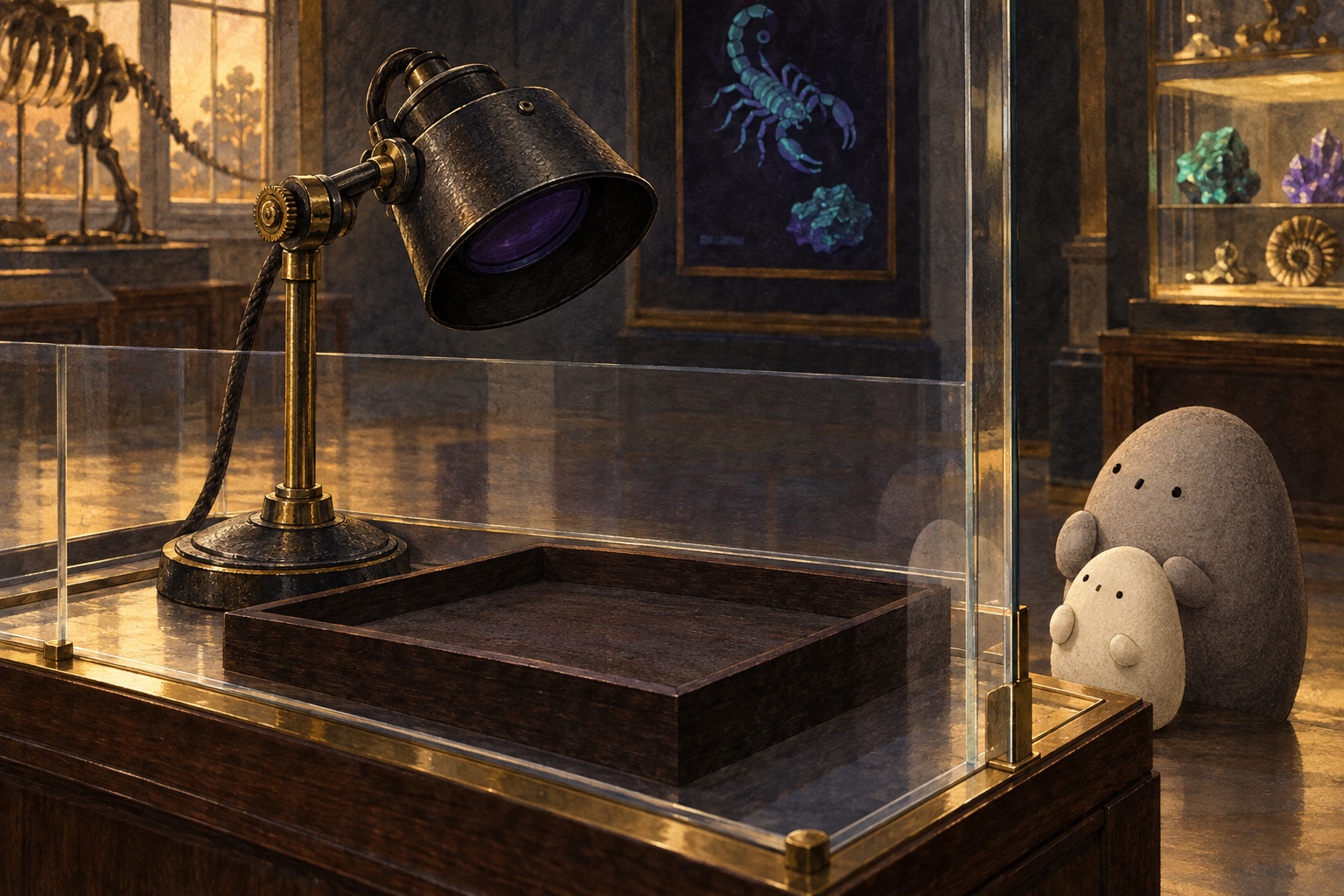
The violet tint is visible light at the lamp.
Is a black light really sending out darkness?
Look at the lamp's dim violet face and the space beneath it. A picture cannot show invisible light directly. What could reveal its presence?
A little explanation & something to try
A black light sends out mostly UV-A light. A little visible violet can leak out too; that is the purple we see at the lamp. The invisible UV-A is not darkness. A suitable fluorescent material can help us notice what the lamp is doing.
Try this. Imagine putting the two drawn stars beneath this lamp. Tell which clue you would watch for. The screen model is enough.
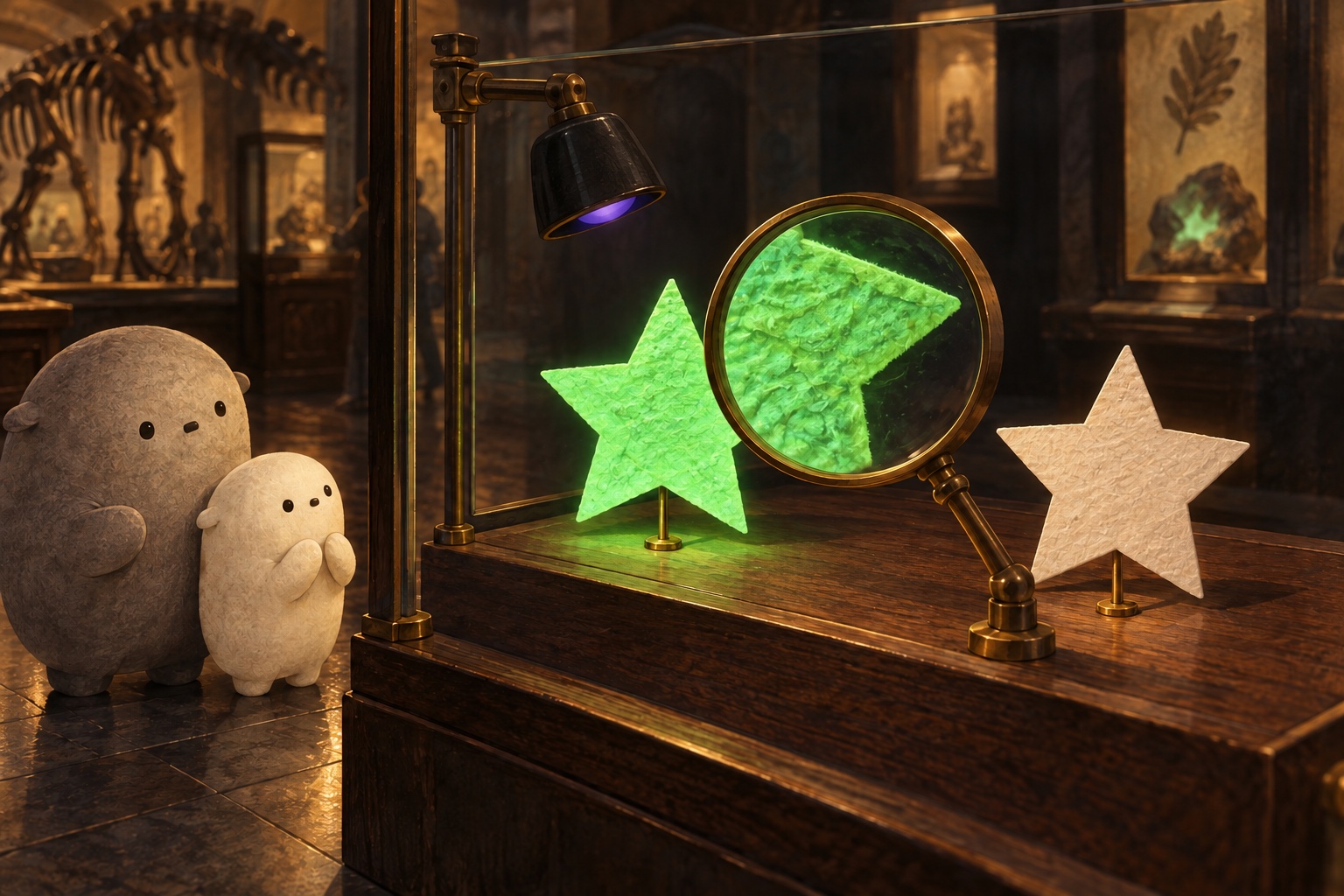
How can a material make a new color of light?
The lens enlarges the star's coating. Follow the idea from lamp to coating to green glow. Where is the visible light coming from?
A little explanation & something to try
A phosphor is a material that can take in energy and give out light. Here a fluorescent phosphor takes in UV-A and quickly gives out visible green light. Some fluorescent dyes do this too. The quick re-glow is called fluorescence. Different materials can glow in different colors, or show no glow under this lamp.
Try this. Tell a three-part path using these words: UV-A in, material, visible light out. Draw arrows if they help.
The light we cannot see
The light we cannot see.
Two paper stars
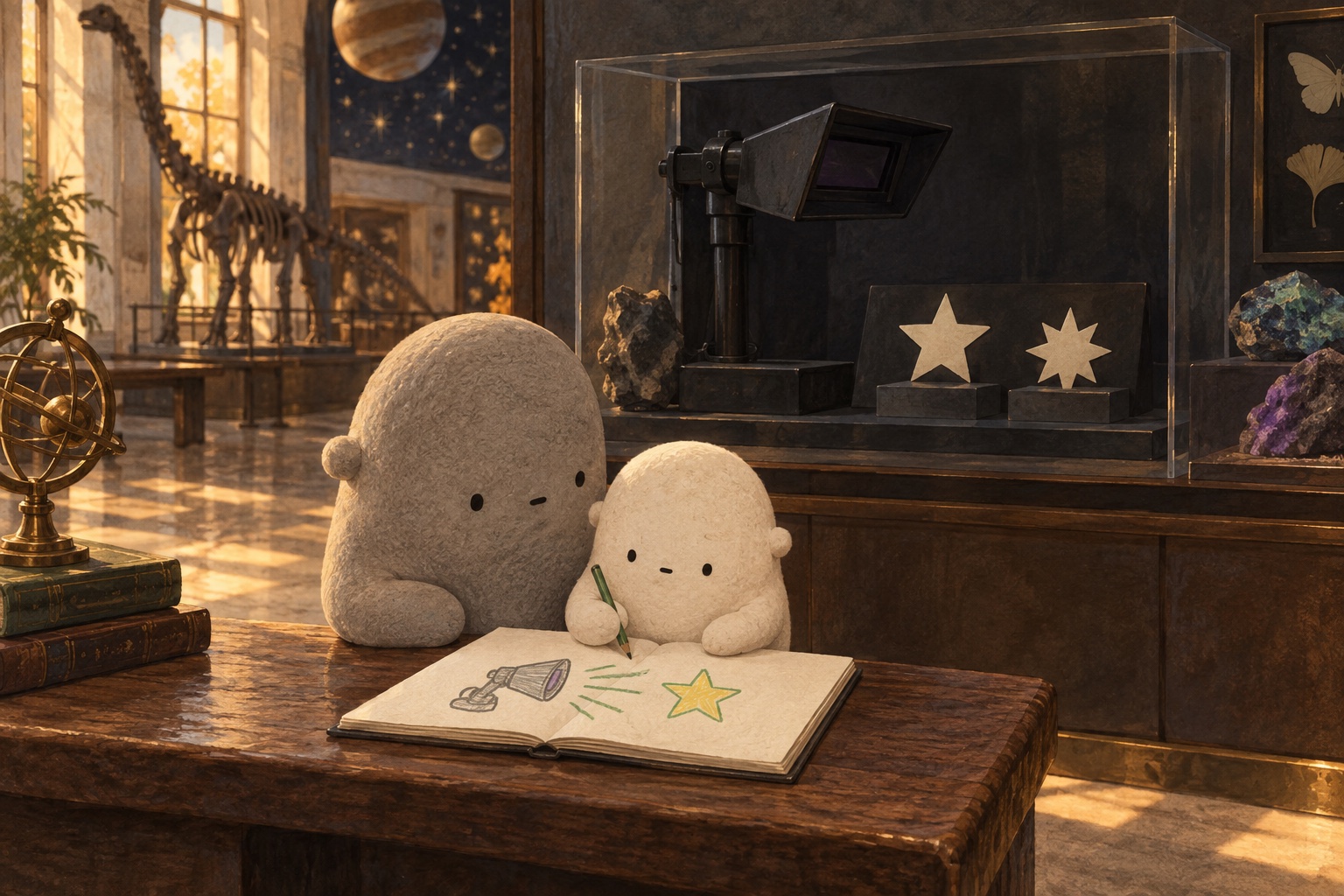
A green star shines in a quiet museum case. Beside it, a cream star stays dull. Both sit under the same dark-looking lamp. “Is one full of tiny lights?” Little asks. Big leans closer. The two stars have left them a puzzle.
What would you compare first? Keep your guess.
Beyond violet
Their search begins long ago. In 1801, Johann Ritter spread sunlight into a rainbow. Light-sensitive material darkened just beyond violet, where he could see no light. An unseen kind of light was there! Today we call it ultraviolet, or UV. “A clue past the rainbow,” Little says.
How did Ritter find a clue to light he could not see?
A name for the glow
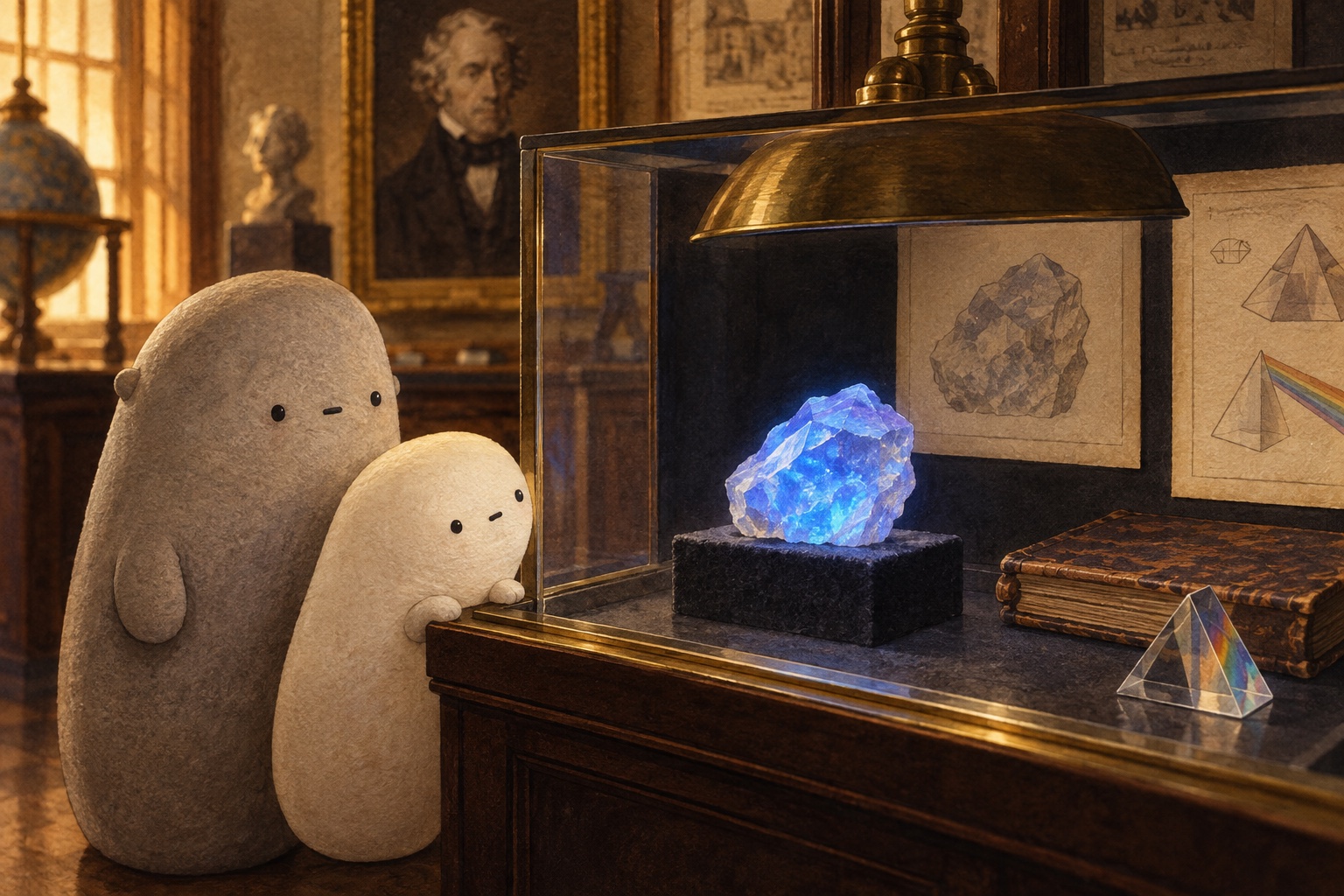
Another display tells of George Stokes. In 1852, he studied materials that took in light and gave out a different color. He called the glow fluorescence. A crystal gleams blue in the case. “Could our star be doing that?” Little wonders. The old discoveries offer a new clue.
What name did Stokes give this kind of glow?
A dark-looking light
Back at the stars, Little studies the black light. It gives out mostly UV-A, the ultraviolet near visible violet. Our eyes cannot see UV-A. A little visible violet makes the lamp look purple. “It isn't sending out darkness,” Little says. “It's sending light we cannot see!”
Is the purple we see the invisible UV-A?
Light in, light out
The green star has a special coating: a fluorescent phosphor. It absorbs UV-A and quickly emits green light. Absorb means take in; emit means give out. That re-glow is fluorescence. The plain star lacks this coating. “Same shape, different material!” Little says. The glow comes from the star itself.
Follow the light into the coating and back out. What changes?
Keep the clue
The museum lamp switches off. The green fluorescence stops almost at once. Little sketches a lamp, a star, and light coming out. “No tiny lights inside,” Little says. “A material makes the re-glow.” Big leaves room on the page. What other material might hold a clue?
For a complete still story, download the foldable book.
A little strip of light
Our spectrum strip has seven named places. Start at UV-A and move toward red.
The dark sample is a clue to unseen UV.
A simplified strip · Positions only
Light
UV-A
Violet
Blue
Green
Yellow
Orange
Red
Place
1
2
3
4
5
6
7
Wavelength is the space from one wave crest to the next. Imagine how stretched out a drawn wave looks. Along our strip toward red, wavelengths get longer. Which end would have more closely spaced crests?
1. There are 7 places. One is unseen UV-A. How many places name visible colors?
7 − 1 =
A small hint
Count the names from violet through red.
2. Start at place 1, UV-A. How many one-place hops reach place 7, red?
7 − 1 =
A small hint
Count the gaps you cross, not the place where you start.
3. Green is at place 4. Red is at place 7. How many places farther along is red?
7 − 4 =
A small hint
Hop from 4 to 5, then 6, then 7.
Give the glow a path.
Choose one scene. Say what the clue helped Little discover. Draw, label, or write one idea.
The dark sample is a clue to unseen UV.
The dark patch was a clue because …What was reaching it?
The coating takes in …What light goes in? What light comes out?
A drawing keeps the idea after the fluorescence stops. Fluorescence fades very quickly when the incoming light stops.
When the lamp goes off, …What happens to fluorescence?
Draw a clue from your scene. Add an arrow to show where light goes or a label to name a change.
SAY IT FIRST. THEN DRAW OR WRITE.
A temporary space. Copy your words before closing or reloading; they are not saved or sent.
UV-Aphosphorabsorbemitfluorescencevisibleclue
Point to the detail your words explain. If you write a sentence, check its first capital and ending mark.
The glow workbench
Show me how the star makes visible light.
Welcome words, pointing, or a sketch. Its fluorescent phosphor absorbs UV-A and emits visible light. That quick re-glow is fluorescence.
You can stop here.
Follow the unseen light
Predict. Could two stars under one lamp look different?
Arrange in words. Name a UV-A lamp, a paper star, and its fluorescent phosphor coating.
Activate in your imagination. UV-A reaches the coating. It absorbs that light and emits visible green light.
Notice. The material matters. A plain star may show no glow. When the lamp stops, fluorescence stops almost at once.
Point, draw, or explain aloud.
Quiz
Answer key
Quiz 1
UV-A: ultraviolet light near visible violet.
Quiz 2
It absorbs UV-A and emits visible light.
Quiz 3
Fluorescence.
Quiz 4
Suitable phosphors or fluorescent dyes can glow; other materials may show no noticeable fluorescence under that lamp.
A little book of unseen light.
A drawing keeps the idea after the fluorescence stops. Fluorescence fades very quickly when the incoming light stops.Download foldable story ↓
US Letter · one-sided · portrait · 100% / actual size. Turn off fit-to-page and browser headers and footers.
Print the PDF and follow the fold guide on its page 8 panel.
An adult makes the single center cut shown by the solid line.
Fold into a little book. The cover, six scenes, and fold guide make eight pages.