Wonder TogetherWONDER DAILYAll mornings

The note inside.

Where does a piano's note come from?

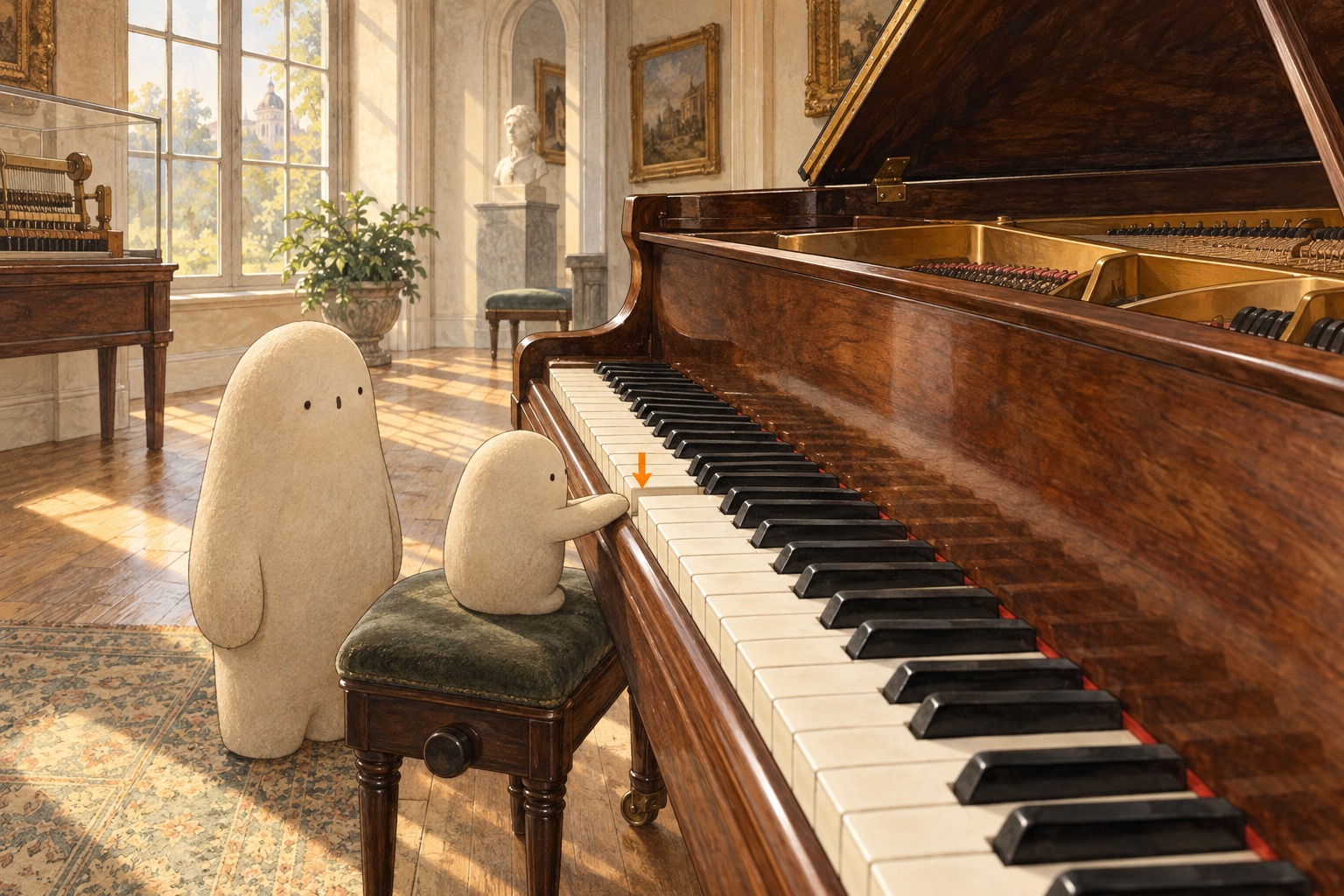
Little Wonderer sits at a walnut grand piano and presses a white key beneath a small orange arrow. Big stands close beside the bench in a sunlit music museum.
A tiny movement begins a question.

Where could a note be hiding?

Find Little's hand and the orange arrow. One key moves only a little. Where would you look for what happens next?

A little explanation & something to try

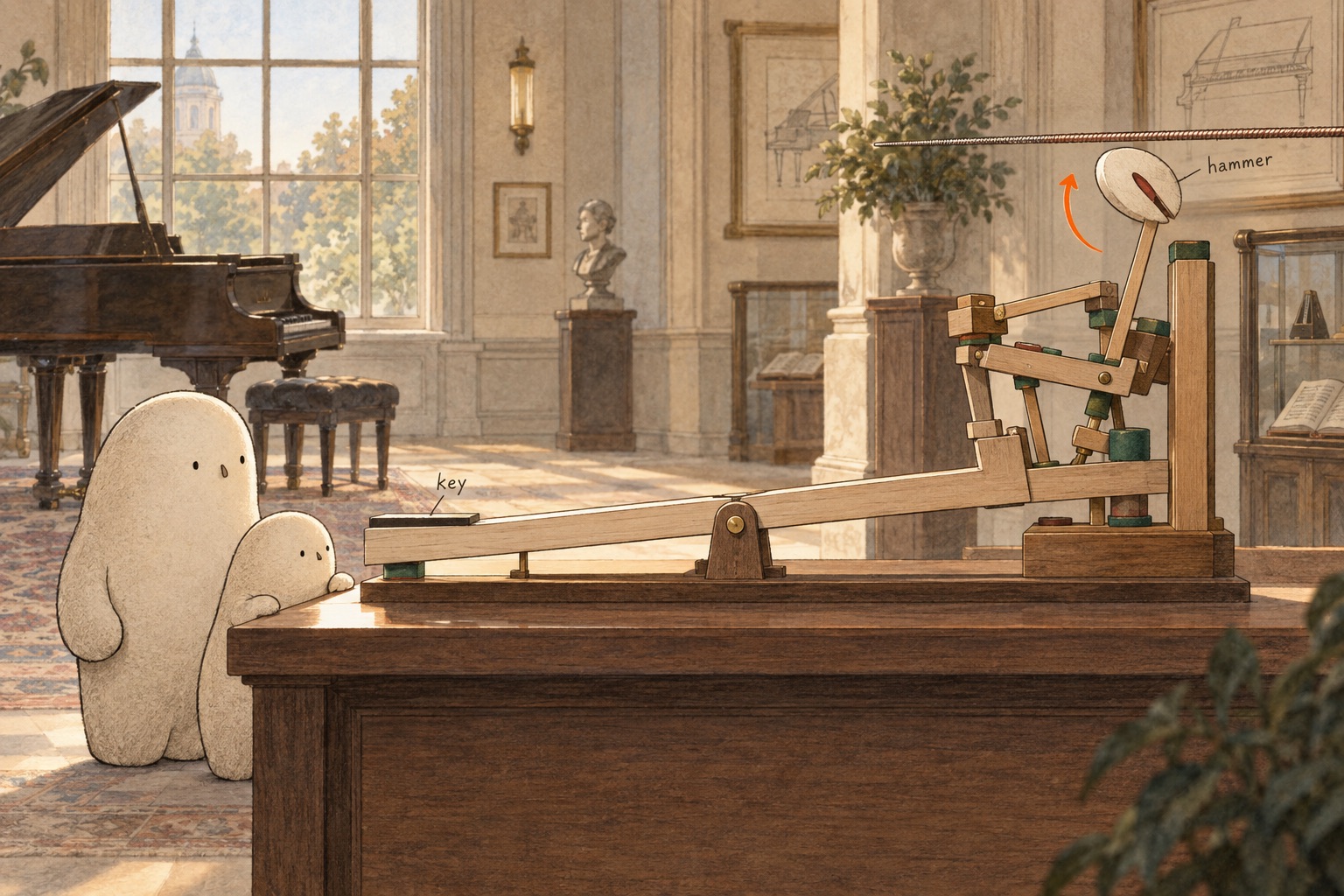
The piano is not a box of stored notes. Pressing a key starts moving parts inside. In an acoustic piano, those parts send a small hammer toward metal strings. The next picture lets us look at a model of that hidden motion.

Try this. Pretend the tabletop is a piano key. Lower one finger quietly, then lift it. Say what you imagine moving inside.
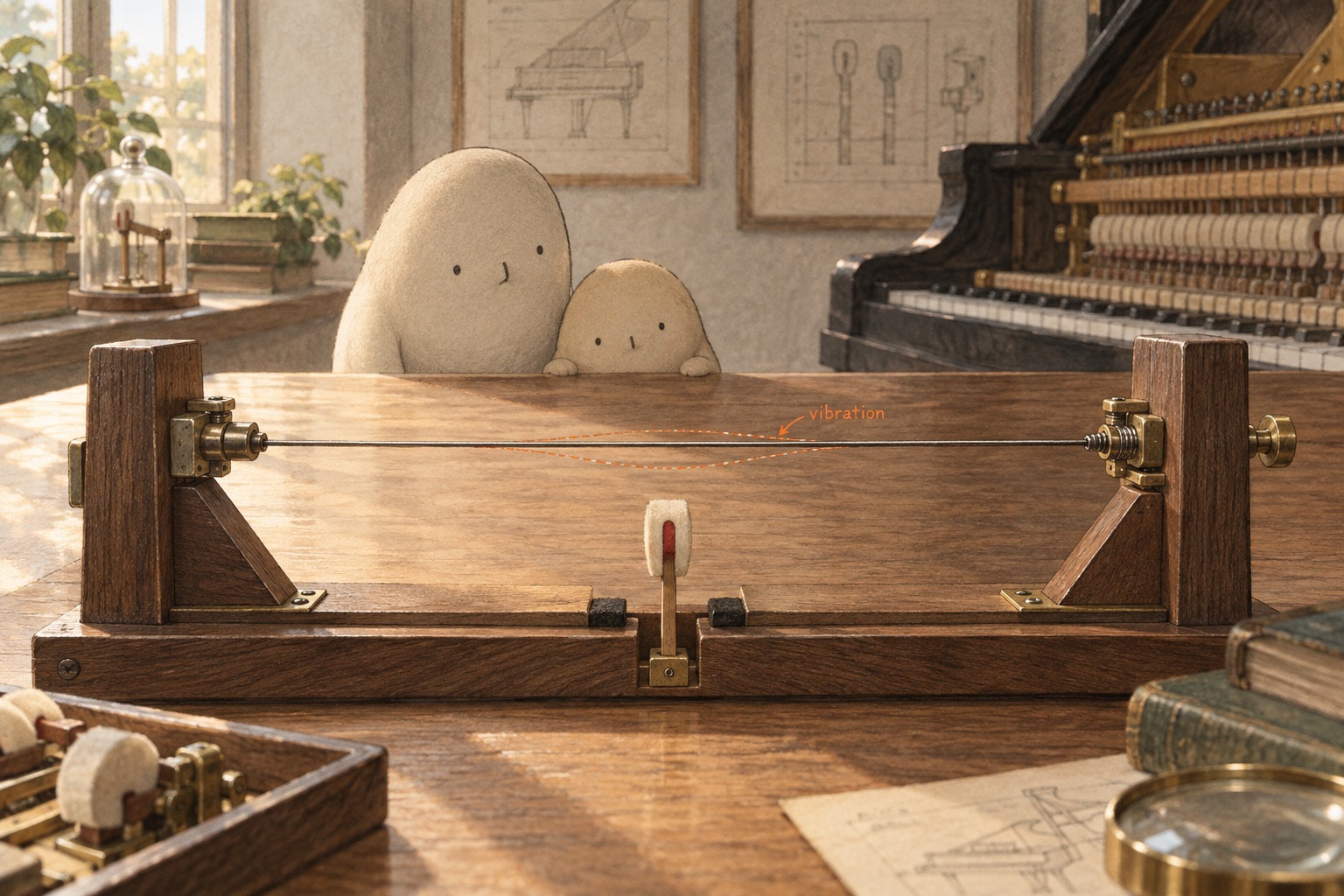
A taut string spans two fixed supports on a museum table. A felt hammer sits below it with a clear gap. Faint orange traces show back-and-forth motion as Big and Little watch.

How can a string keep singing after one tap?

Find the gap between the hammer and the string. Look for the two faint orange traces. What might they help us imagine?

A little explanation & something to try

A hammer taps the string and falls away. The string keeps moving back and forth very quickly. That motion is vibration. The orange traces exaggerate the movement; they are not extra strings. The vibration gradually fades unless something stops it sooner.

Try this. Move one finger a tiny distance back and forth in the air. Let it become still. Say when your pretend string could make sound.

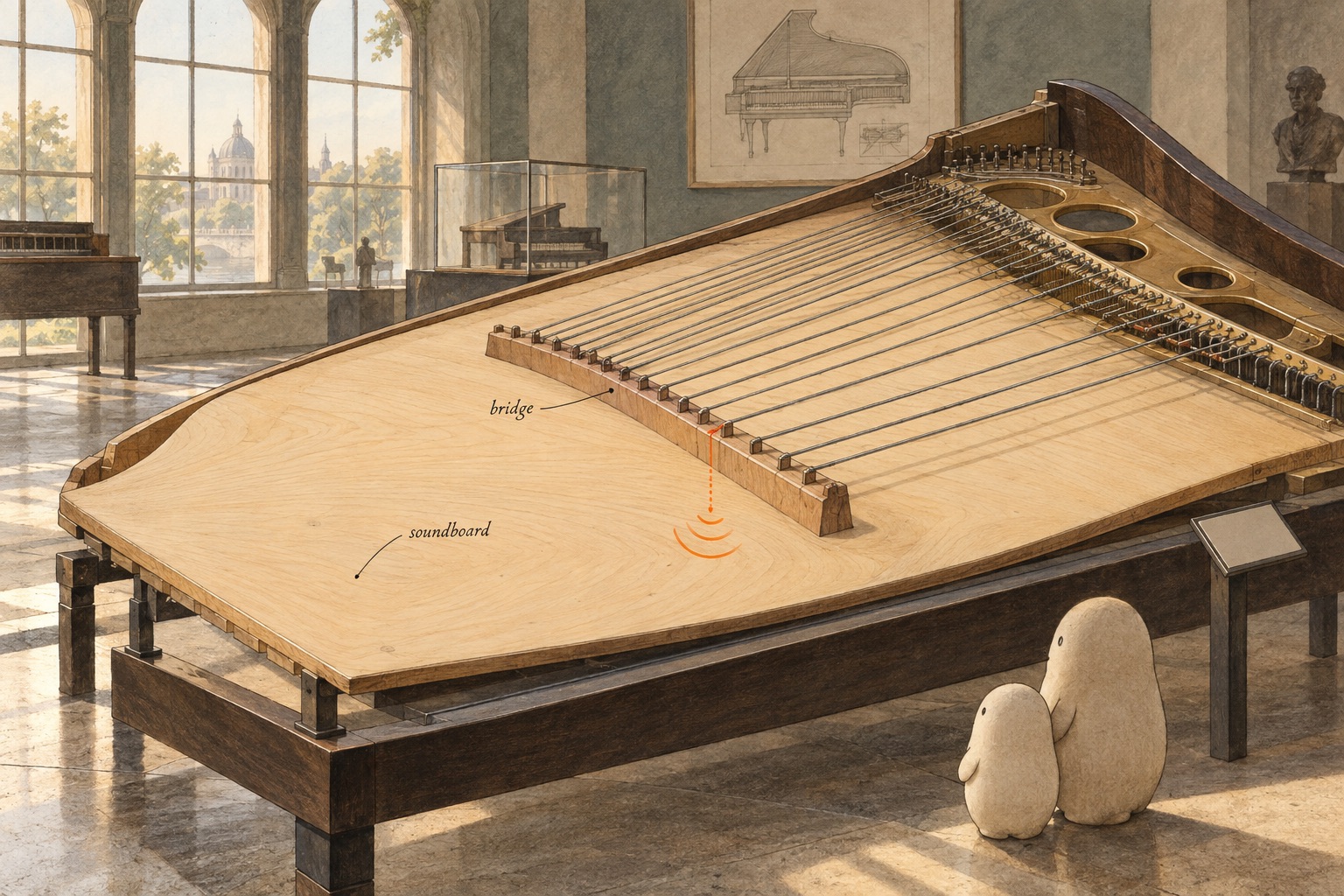
The pair look at a broad pale wooden soundboard in a cutaway display. Strings meet a raised wooden bridge; an orange mark continues from the bridge into the board.
The bridge carries vibration into the soundboard.

How does a thin string fill a room with sound?

Find the narrow raised bridge and the broad wooden board. Where do the strings meet the bridge? Follow the orange mark into the wood.

A little explanation & something to try

A thin string alone moves little air. Its vibration passes through the bridge into the soundboard. This broad wooden board vibrates too, moving more air. The moving air carries sound to our ears. The wood helps us hear a small string's motion.

Try this. Trace the path with your finger: string, bridge, soundboard. Finish by pointing toward your ear. What helped the motion reach you?

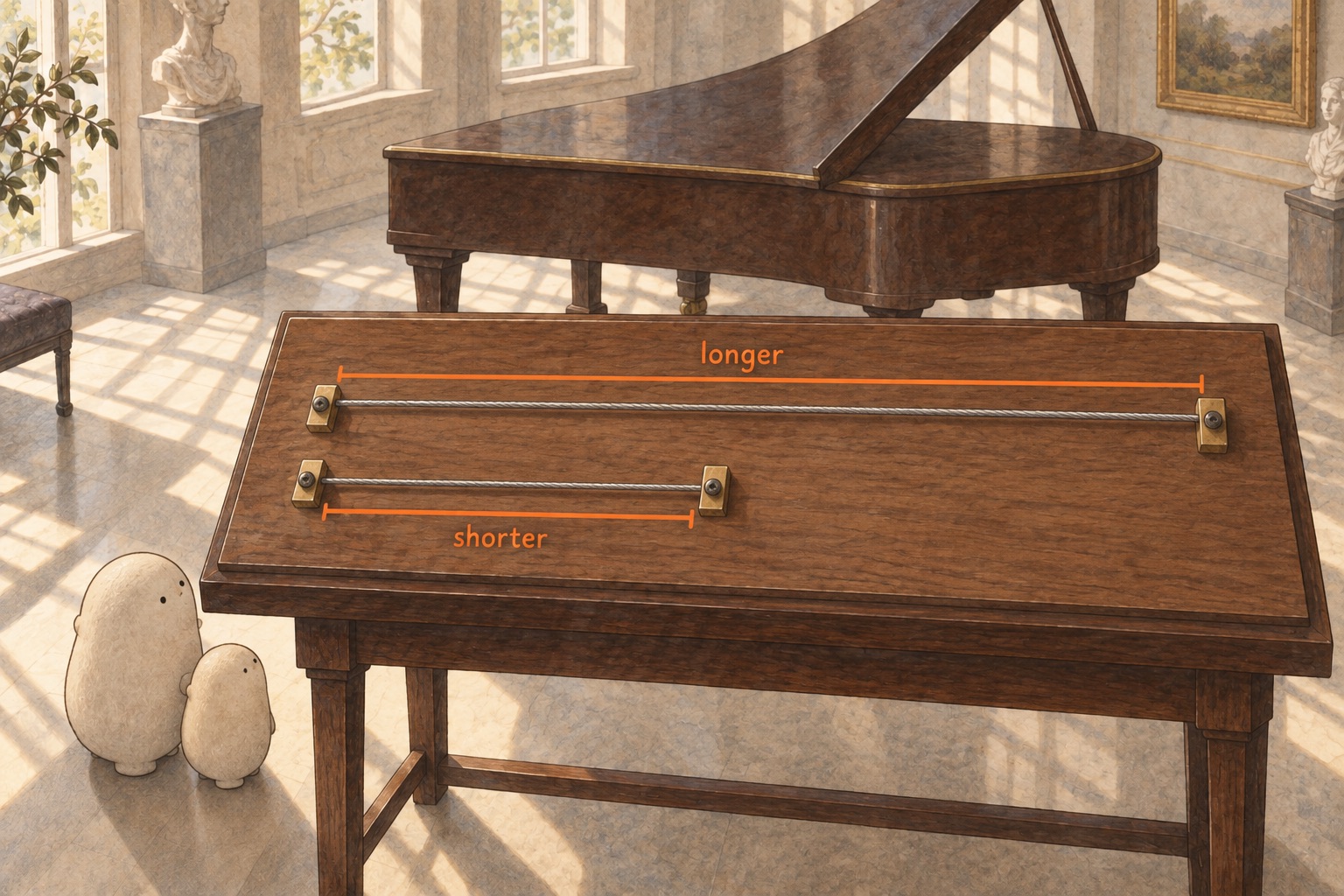
Big and Little examine two separate taut strings on a wooden display. Orange brackets labeled longer and shorter follow the distance between each string's supports.
Compare length while imagining the material, thickness, and tension stay the same.

Why do the two ends of a piano sound different?

The display has two strings. Trace each from one support to the other. What is different about the distance between the supports?

A little explanation & something to try

Pitch means how high or low a note sounds. With other things the same, a longer string gives a lower pitch and a shorter one gives a higher pitch. Tightening the same string raises its pitch; loosening it lowers the pitch. In a piano, length, thickness, and tension work together. Low notes are toward the player's left; high notes are toward the right.

Try this. Use your voice to make a comfortable low hum, then a higher hum. Keep both gentle. Can a high sound be quiet too?

Try together · Piano

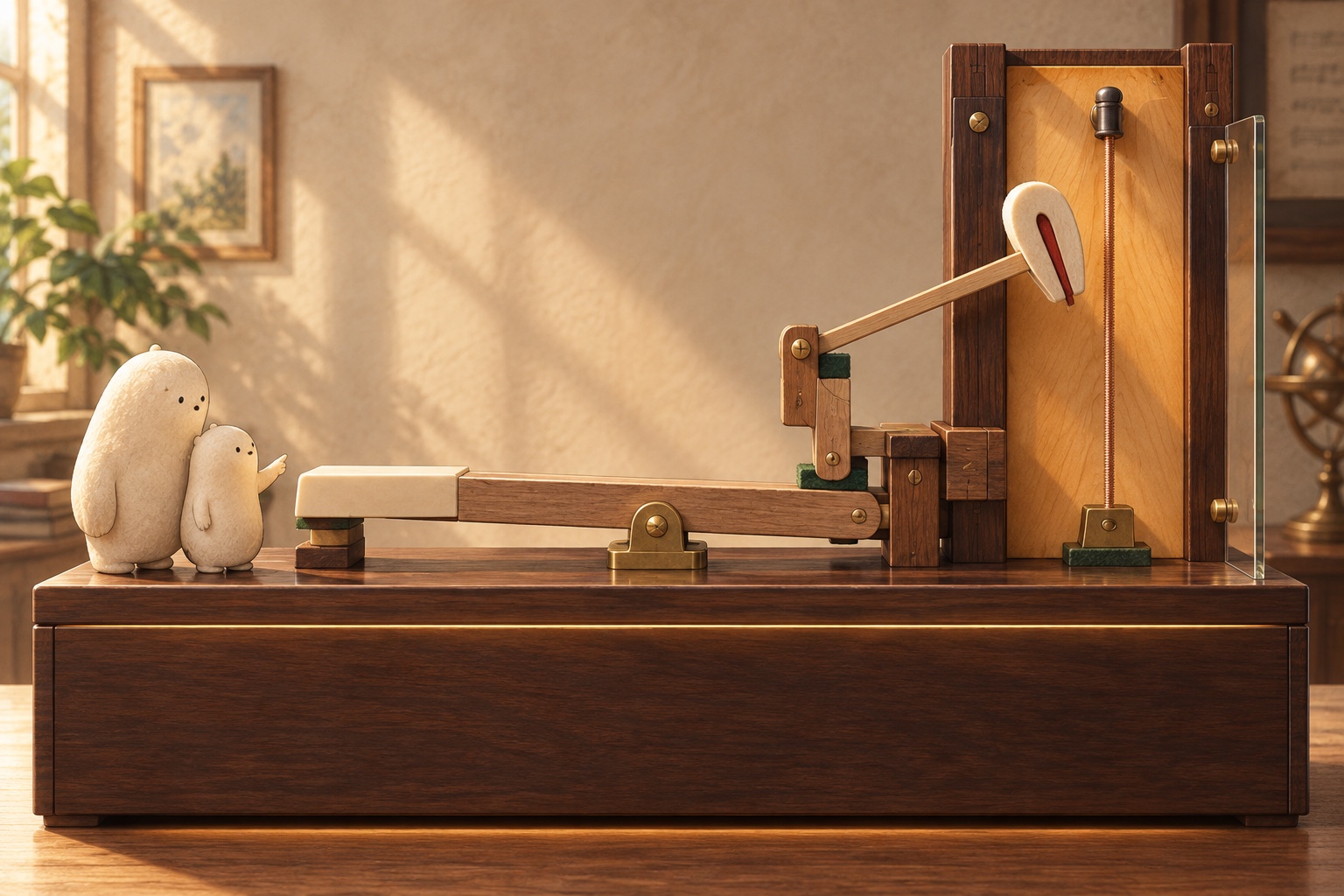
Big and Little Wonderer study a wooden piano model together. One ivory key connects to a felt hammer beside a copper string.

A small press.
A little wonder.

Follow a note from
key to hammer to string.

  1. Predict
  2. Place
  3. Press
  4. Notice

The note inside

Little Wonderer sits at a walnut grand piano and presses a white key beneath a small orange arrow. Big stands close beside the bench in a sunlit music museum.

The note inside.

Little Wonderer sits at a walnut grand piano and presses a white key beneath a small orange arrow. Big stands close beside the bench in a sunlit music museum.

One small press

One key sinks beneath Little's hand. A note rings through the museum. “Was it hiding in there?” Little asks. Big listens beside the bench. The key hardly moved. Something inside the piano must have done much more.

What would you look for inside? Keep your guess for the next picture.

Big and Little study an enlarged wooden key-action model. A long key tilts on a pivot; connected parts lift a felt hammer toward a horizontal string above it.

A hidden tap

An enormous model gives them a peek. A key tips; connected parts lift a felt-covered hammer. Tap! The hammer strikes a string and comes away. “A tiny hammer?” Little whispers. This team of moving parts is called the action — the key's small press becomes a tap.

Follow the model from key to hammer. Why might the hammer need to come away?

A taut string spans two fixed supports on a museum table. A felt hammer sits below it with a clear gap. Faint orange traces show back-and-forth motion as Big and Little watch.

After the tap

The hammer has fallen back, but the string is not still. It quivers: back and forth, back and forth. That quick motion is vibration. “The tap is over,” Little says, “but the moving isn't!” How can such a thin string sound so big?

Find the gap. What keeps moving after the hammer's tap?

The pair look at a broad pale wooden soundboard in a cutaway display. Strings meet a raised wooden bridge; an orange mark continues from the bridge into the board.

The wood joins in

Little follows the same string to a wooden bridge. The bridge carries vibration into a broad soundboard. That wood vibrates too, moving more air. The air carries sound to listening ears. “The wood joins in!” Little says. A thin string has a roomy helper.

Trace the connection into the wood. What does the soundboard help move?

Big and Little examine two separate taut strings on a wooden display. Orange brackets labeled longer and shorter follow the distance between each string's supports.

Two lengths to notice

Two strings stretch across another model. One is longer. If everything else stays the same, the longer string vibrates more slowly and sounds lower. The shorter one sounds higher. “Different voices!” says Little. How high or low a note sounds is its pitch.

Point to the string you predict would sound lower. What must stay the same for this comparison?

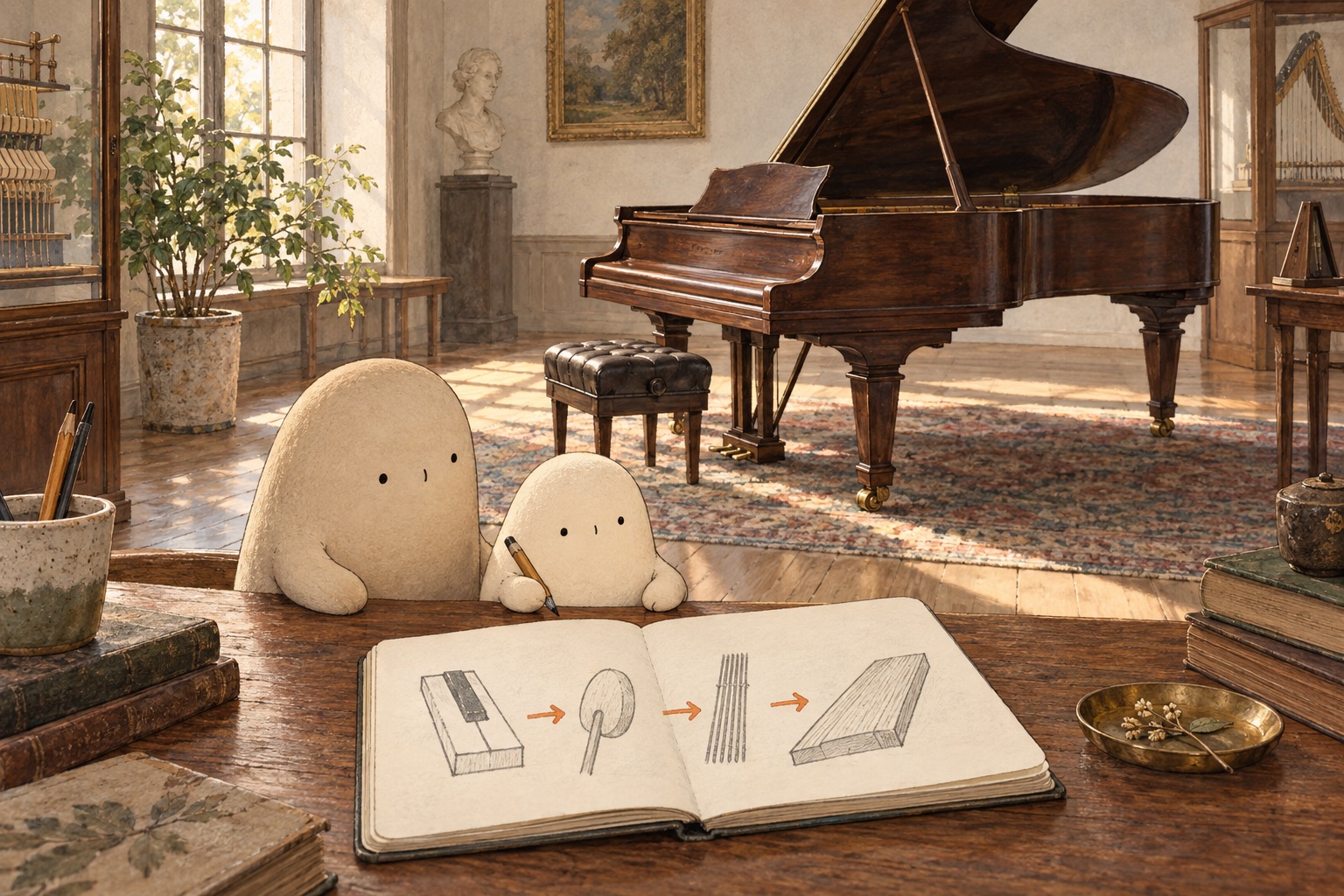
Big and Little share a notebook near the quiet piano. Little holds a pencil above sketches of a key, a hammer, strings, and a wooden board joined by orange arrows.

Keep the path

With the pedal up, Little releases a middle key. A felt damper hushes its strings. Little sketches key, hammer, strings, wood. “The note wasn't hiding. We set things moving!” Big leaves room for one more why.

What changed Little's first guess? What connection could you add to the sketch?

Next: Math
For a complete still story, download the foldable book.

Longer by how much?

Little wants two string lines for a drawing. Imagine line A is 24 centimeters long and line B is 9 centimeters long. Use the lengths in the table.

Big and Little examine two separate taut strings on a wooden display. Orange brackets labeled longer and shorter follow the distance between each string's supports.
Compare length while imagining the material, thickness, and tension stay the same.
Drawing lengths · Centimeters
LineAB
Length (cm)249

Sketch two bars that start at the same place. Show which part is the extra 15 cm. A sketch need not be actual size.

1. Line A is 24 cm long. Line B is 9 cm long. How much longer is A?

24 − 9 =

A small hint

Hop from 9 to 10, then to 20, then to 24. Add your hops.

2. Imagine drawing A and B end to end. What is their total length?

24 + 9 =

A small hint

Add 6 to reach 30. How much of the 9 is left?

3. Little erases 6 cm from line A. How long is that line now?

24 − 6 =

A small hint

Take away 4 to reach 20, then take away 2 more.

Give the note a path.

Choose one picture from Little's search. Tell what moves and what happens next. Draw or write a clue that helped you understand the note.

Big and Little study an enlarged wooden key-action model. A long key tilts on a pivot; connected parts lift a felt hammer toward a horizontal string above it.
The key starts linked parts moving; the hammer taps and comes away.

When a key moves, …What does the action help the hammer do?

The pair look at a broad pale wooden soundboard in a cutaway display. Strings meet a raised wooden bridge; an orange mark continues from the bridge into the board.
The bridge carries vibration into the soundboard.

The soundboard helps because …How does the broad wood help move air?

Big and Little examine two separate taut strings on a wooden display. Orange brackets labeled longer and shorter follow the distance between each string's supports.
Compare length while imagining the material, thickness, and tension stay the same.

If only the string's length changes, …Which length could make the lower sound?

Draw one detail from your scene. Add an arrow or a label to show a movement or a difference.

SAY IT FIRST. THEN DRAW OR WRITE.

A temporary space. Copy your words before closing or reloading; they are not saved or sent.

keyhammerstringvibrationbridgesoundboardpitch

Read it together and point to the detail your words explain. If you are writing, check the first capital and the ending mark.