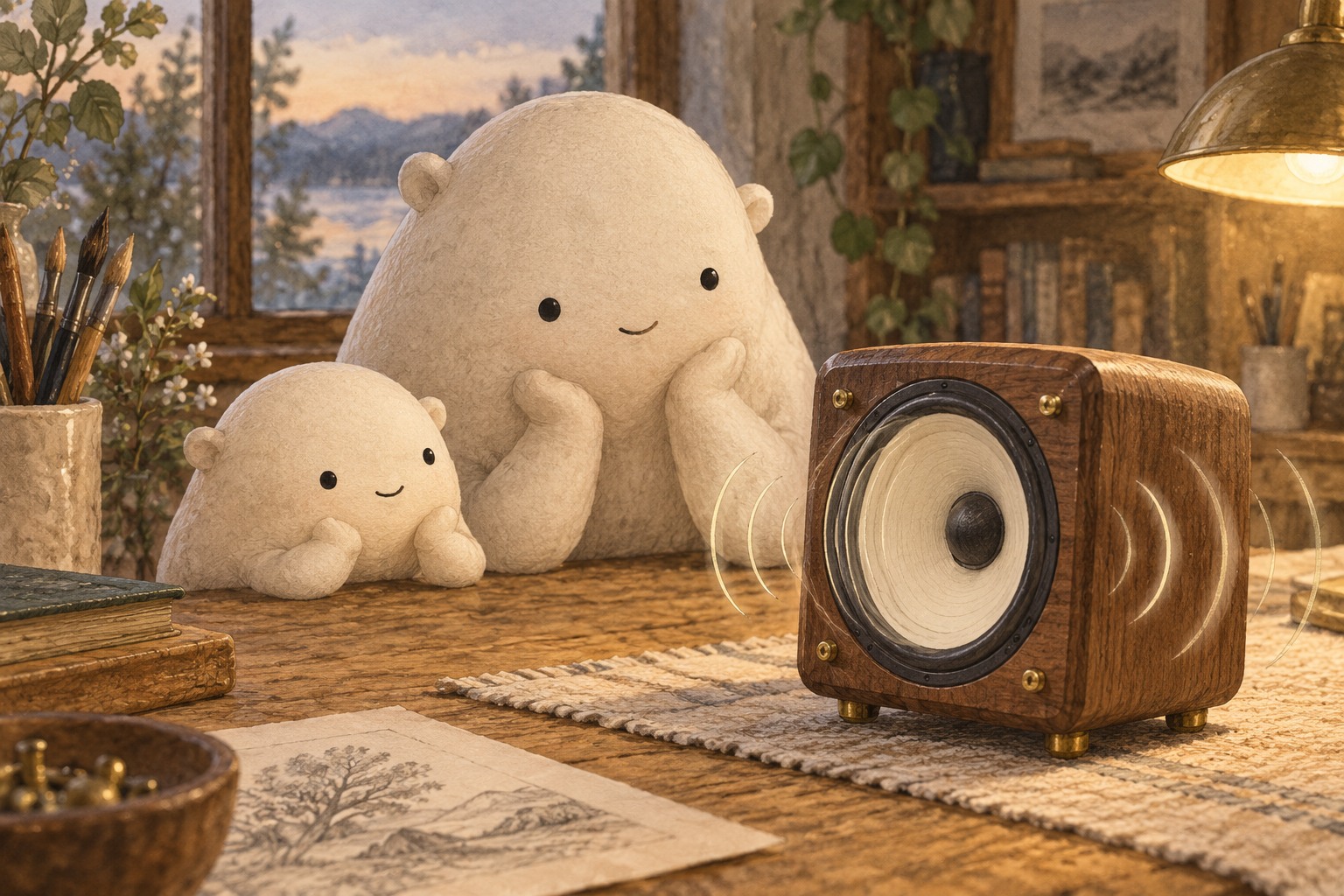
Where does the wiggle go after it leaves the speaker?
Where shall we look?
A speaker gives a smooth signal a moving cone.
How can a wave become a sound?
Find the smooth wiggle beside the speaker.
A little explanation & something to try
Sound begins with vibration, a back-and-forth motion. A speaker turns a changing electric signal into motion. A pure note can follow a sine wave’s smooth wiggle. Music uses many wiggles together.
Try this. Draw a smooth wave, then move your hand gently back and forth to follow its rhythm.
The coil moves the cone, and the cone moves air.
What makes the cone wiggle?
Look for the wide paper cone on the speaker.
A little explanation & something to try
A speaker has a cone made of paper or plastic. A wire coil is attached behind it, near a magnet. The changing electric signal makes the coil push and pull against the magnet. The cone moves with it.
Try this. Use the diorama to follow the coil, the cone, and the air in that order.
A vibrating surface can make rice hop.
Can you see a vibration?
Look just above the tight wrap.
A little explanation & something to try
Rice can hop when the surface under it vibrates. Try a toy drum, or a bowl with plastic wrap pulled tight across its top. A tiny tap makes the motion easier to spot.
Try this. Place a pinch of rice on the tight wrap or a toy drum. Hum or sing softly nearby and look closely. If the rice stays still, gently tap the bowl’s side or the drum rim. Draw what changes. Keep Big beside you, sounds gentle, and rice on the table, away from mouths and ears. Leave devices closed; use no wall power or soldering, and let Big hold any magnet.
Pressure waves make an eardrum vibrate.
How does the wiggle reach your ear?
Follow the air-wave marks toward the ear.
A little explanation & something to try
The cone squeezes air, then lets it spread out. These pressure changes travel as a wave. At your ear, the eardrum vibrates. Faster wiggles make a higher pitch. Bigger wiggles make a louder sound.
Try this. Draw a path from speaker to air to ear. Add one question about where the wiggle goes next.
Follow the little wiggle
How Speakers Turn Waves Into Sound
A wiggle begins
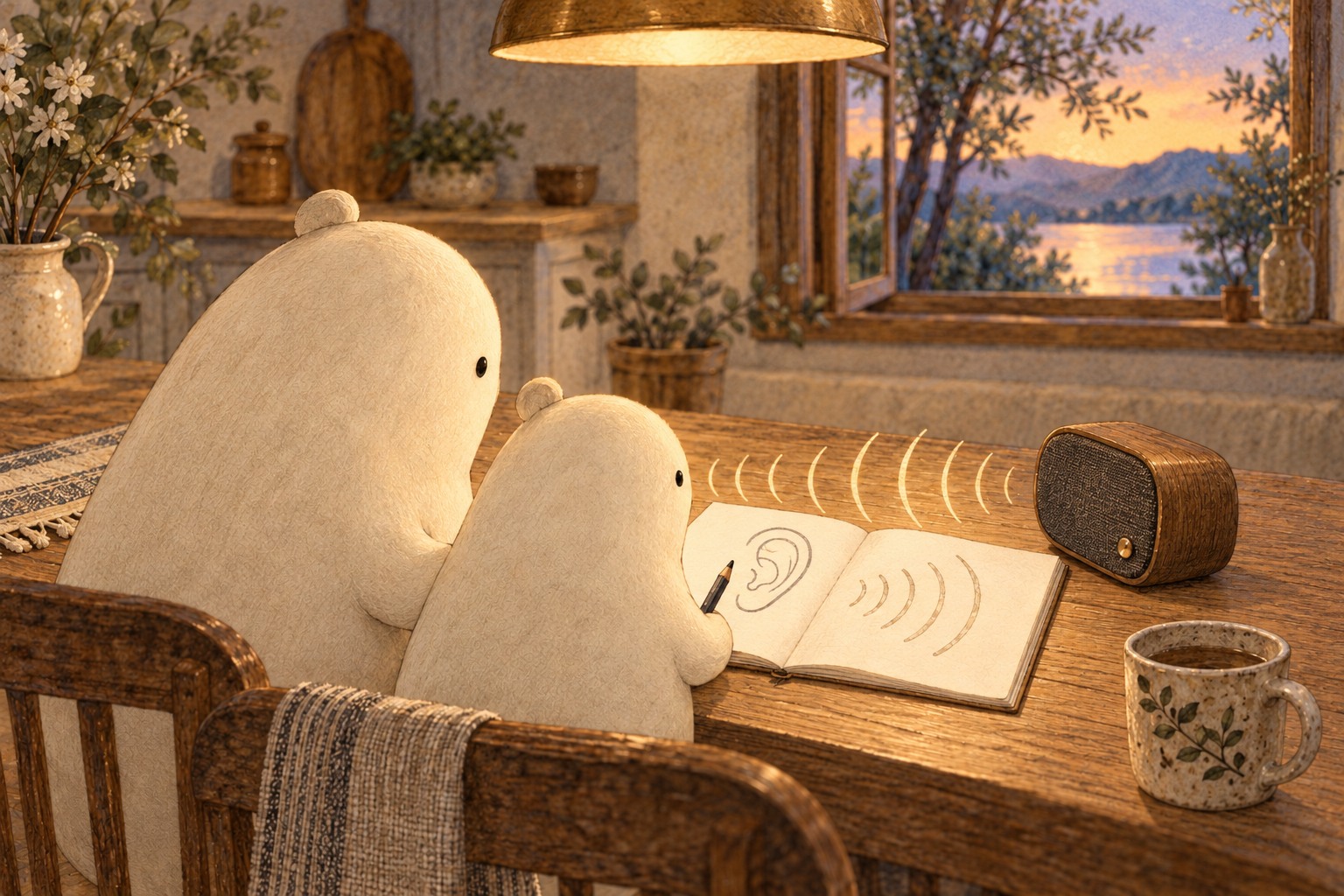
A soft note came from the speaker on the table. Little Wonderer found the smooth wave drawn in the notebook. “Could that wiggle become a sound?” Big Wonderer nodded. A speaker changes an electric signal into vibration: a back-and-forth motion. For a pure note, that motion follows the smooth shape of a sine wave.
What changes inside a speaker when it makes a note?
A cone moves air
The speaker’s cone was a thin piece of paper shaped like a shallow bowl. Behind it, a coil of wire sat near a magnet. The changing signal made the coil push and pull against the magnet. The attached cone moved back and forth, squeezing nearby air, then letting it spread out.
Why does the cone move when the coil moves?
Rice gives a clue
Big stretched plastic wrap over a bowl and added a pinch of rice. Little hummed nearby. Nothing moved yet. Big gently tapped the bowl, and a few grains hopped. The tight wrap was vibrating beneath them. Rice made a small motion easier to see. Little drew the tiny hops.
What does the moving rice tell you about the wrap?
A drum can wiggle too
A toy drum waited beside the bowl. Big gave its rim a gentle tap. Rice on the drumhead bounced. The drumhead and the bowl’s wrap could both vibrate. Faster wiggles make a higher pitch, or higher-sounding note. Bigger wiggles make a louder sound. Little kept the taps soft.
How is a higher sound different from a louder sound?
Another path for a wiggle
Big spoke softly into a paper cup. Little listened at a second cup, joined by a taut string. The first cup’s bottom vibrated. The string carried the motion to the other cup. That cup moved the air near Little’s ear. A wiggle could travel through more than air.
What carries the vibration between the two cups?
The wiggle reaches you
A pattern of squeezed and spread-out air traveled as pressure waves. Air wiggled in place. Little’s eardrum vibrated, helping the ear sense sound. “Where does the wiggle go after it leaves the speaker?” Little wondered.
How does the wiggle get from the cone to your ear?
For a complete still story, download the foldable book.
Count the little wiggles
Add or subtract. Trade a ten when you need one.
A drumhead can pass its wiggle to rice.
Choose one task and show the trade with tens and ones.
1. Little marks 27 cone wiggles, then 36 more. How many wiggles are marked?
27 + 36 =
A small hint
Add the ones, then trade 10 ones for 1 ten.
2. Of 64 rice grains on the drum, 28 hop during a gentle tap. How many stay still?
64 − 28 =
A small hint
Trade 1 ten for 10 ones before subtracting 8 ones.
3. Big records 38 drum taps on one page and 45 on another. How many taps are recorded?
38 + 45 =
A small hint
Combine the ones first, then regroup a ten.
4. Little draws 72 waves and colors 46 of them. How many waves are left to color?
72 − 46 =
A small hint
Rename 72 as 6 tens and 12 ones.
5. A speaker drawing shows 46 wire loops, then Little adds 29. How many loops are drawn?
46 + 29 =
A small hint
Add 6 ones and 9 ones, then regroup.
6. A notebook has 91 cup-phone turns planned and 57 finished. How many turns remain?
91 − 57 =
A small hint
Rename 91 as 8 tens and 11 ones.
Put a wiggle into words
Give a clear command for watching rice move.
A vibrating surface can make rice hop.
Hum …tell where to make a soft sound
A drumhead can pass its wiggle to rice.
Watch …tell which surface to observe
A taut string carries vibration between cups.
Draw …tell how to show the motion
Draw the bowl before and after a gentle tap. Show the rice.
SAY IT FIRST. THEN DRAW OR WRITE.
A temporary space. Copy your words before closing or reloading; they are not saved or sent.
speakerconecoilmagnetairwaveearricegently
Does your command begin with an action word, such as Hum, Watch, or Draw?
What moves the air?
Look inside a speaker. Follow one little wiggle.
Fig. 01 · Look insideA speaker, cut open
SignalVoice coilMagnetConeAir waves
Motion slowed to help you seeStill cut-away · trace the parts
Trace the signal from the wires to the coil, then find the magnet, cone, and air.
Notice: what stays still while the cone moves?
Follow one wiggle
Signal: a changing electrical signal arrives through the wires.
Voice coil: the signal flows through this coil of wire.
Magnet: its steady magnetic field acts on the current in the coil, making the coil move back and forth.
Cone: the coil is attached to this cone. They move together, squeezing and spreading the air.
Air waves: the squeezed and spread-out pattern travels away. Each bit of air wiggles near its own place.
Cut-away motion is enlarged; the air dots show a pattern, not individual molecules. This visual test is silent. Anatomy by Ryan, github.com/wheresryan22/anatomy, MIT.
Quiz
Answer key
Quiz 1
The changing electric signal makes the coil push and pull near the magnet, moving the attached cone.
Quiz 2
Pressure waves carry a pattern of squeezed and spread-out air toward the ear.
Quiz 3
Faster wiggles make a higher pitch; bigger wiggles make a louder sound.
Quiz 4
The drumhead vibrates beneath the rice and gives it little pushes upward.