Wonder TogetherWONDER DAILYAll mornings

Why Electronics Use Sine Waves

Where else do you see a smooth back-and-forth wiggle?

Big and Little lean over a notebook with a smooth sine-shaped line, beside a small speaker and spring.
Little sits on a low wooden swing holding both ropes, with Big close beside it.
A gentle swing slows near each turn.

What is a sine wave?

Notice how the swing slows near the end of its trip.

A little explanation & something to try

A sine wave is a smooth back-and-forth wiggle that repeats. It can show how a position or an electric push changes over time. A gentle swing moves in a sine-like rhythm; its seat travels along an arc.

Try this. With Big nearby, take a gentle swing, bounce a soft toy spring over a tray, or move a rope from side to side on the floor. Draw the smooth wiggle you notice. Keep wall power and plugged-in devices closed and untouched; these are activities with a swing, spring, rope, paper, or an intact battery speaker.

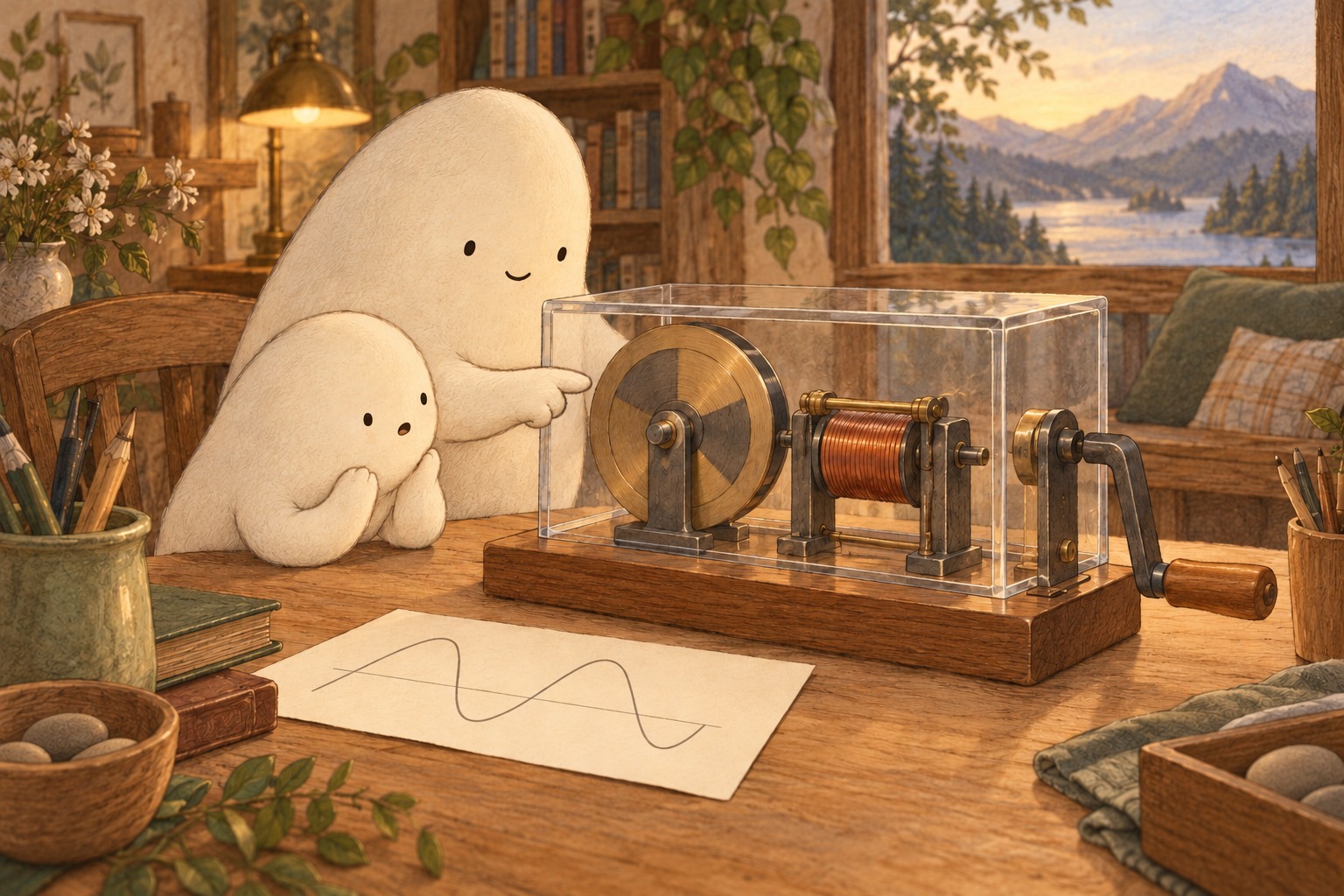
Big and Little examine a hand-cranked teaching model with a disk and wire coil inside a clear case.
Spinning can make a smoothly changing electric push.

How can spinning make a wave?

Find the turning disk beside the wire coil.

A little explanation & something to try

A generator turns motion into electrical energy. As a magnet spins beside wire, the electric push changes smoothly, first one way and then the other. Many generators make the AC power supplied at home. AC means that the push changes direction repeatedly.

Try this. Draw a dot on a paper circle. Turn the circle slowly and watch the dot rise and fall.

Little touches the outer wooden speaker cabinet beside Big and a notebook with a smooth wave drawing.
A speaker moves air to make sound.

What wiggles inside a speaker?

Look at the circle on the front of the speaker.

A little explanation & something to try

The speaker cone moves in and out, making the air nearby squeeze and spread. Those changes travel to your ears as sound. For a pure, steady tone, the cone moves in a sine-like rhythm. Music and voices make more complicated wiggles.

Try this. Let Big set an intact battery speaker to low volume. Rest fingertips lightly on its outer case, leaving the cone alone, and notice any quiet buzz. A drawing of the cone’s motion works too.

Big and Little lean over a notebook with a smooth sine-shaped line, beside a small speaker and spring.
A sine wave is a smooth, repeating wiggle.

Why use a smooth wiggle?

Follow the rounded turns in Little’s notebook.

A little explanation & something to try

Spinning parts can make sine waves naturally. Smooth changes help many motors and speakers work evenly. Sudden jumps can make extra buzz or jerky starts. Electronics also use steady power and other signal shapes; not every signal is a sine wave.

Try this. Draw a smooth wave and a zigzag. Trace them slowly with a finger and compare the turns.

Follow the smooth wiggle

Big and Little lean over a notebook with a smooth sine-shaped line, beside a small speaker and spring.

Why Electronics Use Sine Waves

Big and Little lean over a notebook with a smooth sine-shaped line, beside a small speaker and spring.

A line with a rhythm

Little Wonderer drew a line that rose, curved over, and dipped down. Again and again, it made the same smooth wiggle. “That shape is called a sine wave,” said Big Wonderer. Sine is the math name for this smooth shape. Could a line on paper help explain a swing, a speaker, and electricity?

What repeats in Little’s line?

Little sits on a low wooden swing holding both ropes, with Big close beside it.

Slow at the turn

Outside, Little took a gentle swing. Near each end, the swing slowed, paused, and came back. It moved fastest through the middle. Its seat followed an arc. A sine-like line could show its back-and-forth position as time passed. The line was a record of the motion, not the shape of the seat’s path.

How is a record of motion different from the seat’s path?

Big holds a hanging spring above a tray while Little watches.

A bounce comes back

At the table, Big held a spring above a tray. A spring is a coil that can stretch and return. Its lower end bounced up and down, slowing near each turn. Little watched the bounces grow smaller. A steady sine wave repeats evenly; this real spring gradually settled as it lost energy to its surroundings.

What changed about the spring’s bounces over time?

Big and Little hold a soft rope that curves across the living-room floor.

A wiggle travels

Little moved one end of a rope gently from side to side along the floor. A wiggle traveled toward Big. Bits of rope moved back and forth while the wave moved along. Little drew its rounded shape. Smooth turning felt different from suddenly changing direction. The same kind of curve kept appearing in new places.

What traveled along the rope, and what moved back and forth?

Big and Little examine a hand-cranked teaching model with a disk and wire coil inside a clear case.

A turn makes a push

Big showed a generator: a machine that turns motion into electrical energy. Its magnet spins beside wire. The electric push grows, fades, and reverses smoothly. A sine wave records this change. Many spinning generators make AC power for homes. AC means the push changes direction again and again.

How does spinning change the electric push?

Little touches the outer wooden speaker cabinet beside Big and a notebook with a smooth wave drawing.

A quiet tone

The speaker made a quiet tone. Its cone moved in and out, nudging air. A pure tone follows a sine-like rhythm. Smooth changes help machines work evenly. Electronics use other shapes too. Little wondered, “Where else can we find this smooth wiggle?”


Where else could you notice a smooth wiggle?

For a complete still story, download the foldable book.

Count groups of wiggles

Add the same number for each equal group or row.

Big and Little lean over a notebook with a smooth sine-shaped line, beside a small speaker and spring.
A sine wave is a smooth, repeating wiggle.

Choose one task and draw its equal groups or rows.

1. Little draws 2 groups of swing marks, with 3 marks in each group. How many marks are there?

3 + 3 =

A small hint

Add 3 + 3, one group at a time.

2. Big draws spring bounces in 4 rows, with 2 bounces in each row. How many bounces are drawn?

2 + 2 + 2 + 2 =

A small hint

Add 2 + 2 + 2 + 2 to count the four rows.

3. Little counts 3 sets of rope wiggles, with 3 wiggles in each set. How many wiggles is that?

3 + 3 + 3 =

A small hint

Use 3 + 3 + 3 to count all three sets.

4. A page has 3 rows of wave drawings, with 4 drawings in each row. How many drawings are on the page?

4 + 4 + 4 =

A small hint

Add 4 + 4 + 4 for the three equal rows.

5. Big counts 5 groups of crank turns, with 3 turns in each group. How many turns does Big count?

3 + 3 + 3 + 3 + 3 =

A small hint

Try 3 + 3 + 3 + 3 + 3, adding one group at a time.

6. Little draws speaker wiggles in 4 rows, with 5 wiggles in each row. How many wiggles are drawn?

5 + 5 + 5 + 5 =

A small hint

Use 5 + 5 + 5 + 5 to count the four rows.

Give a wiggle its words

Say one clear command, then draw or write it.

Little sits on a low wooden swing holding both ropes, with Big close beside it.
A gentle swing slows near each turn.

Swing …tell how to move gently

Big holds a hanging spring above a tray while Little watches.
A spring can bounce up and down.

Watch …tell what to notice about a bounce

Big and Little hold a soft rope that curves across the living-room floor.
The wiggle travels along the rope.

Draw …describe the smooth wiggle

Draw a swing, a spring, or a rope. Show which way it moves.

SAY IT FIRST. THEN DRAW OR WRITE.

A temporary space. Copy your words before closing or reloading; they are not saved or sent.

sine wavewiggleswingspringsmoothgentlybackforth

Does your command tell what to do, using a word such as Swing, Watch, or Draw?

Trace a smooth wiggle

A paper-strip wave tracerA marker moves up and down while paper slides left. The smooth motion leaves rounded turns in its line. 0 percent of two wiggles is drawn.

Follow a smooth wiggle

  1. Imagine paper sliding past a marker that moves up and down. Which kind of turn will it draw?
  2. With smooth motion, the marker slows near the top and bottom. The line has rounded turns: a sine wave.
  3. With zigzag motion, the marker changes direction suddenly. The line has corners.
  4. A gentle swing has a sine-like rhythm. A spinning generator’s electric push and a speaker making a pure tone can follow this smooth shape too.

Quiz

1. Which description best fits a sine wave?

2. What does a generator change into electrical energy?

3. How does a speaker make sound?

4. Do electronics use only sine waves?

Answer key
Quiz 1
A sine wave is a smooth, repeating wiggle.
Quiz 2
A generator changes turning motion into electrical energy; its electric push can change smoothly as it spins.
Quiz 3
The cone moves in and out, nudging air. For a pure tone, it follows a sine-like rhythm.
Quiz 4
Electronics also use other signal shapes and steady power. Sine waves are useful, but they are not the only kind.

A smooth back-and-forth wiggle

Little touches the outer wooden speaker cabinet beside Big and a notebook with a smooth wave drawing.
A speaker moves air to make sound.
Download foldable story ↓

US Letter · one-sided · portrait · 100% / actual size. Turn off fit-to-page and browser headers and footers.

  1. Print the PDF and follow the fold guide on its page 8 panel.
  2. An adult makes the single center cut shown by the solid line.
  3. Fold into a little book. The cover, six scenes, and fold guide make eight pages.