Could a diamond flash where no light can reach it?
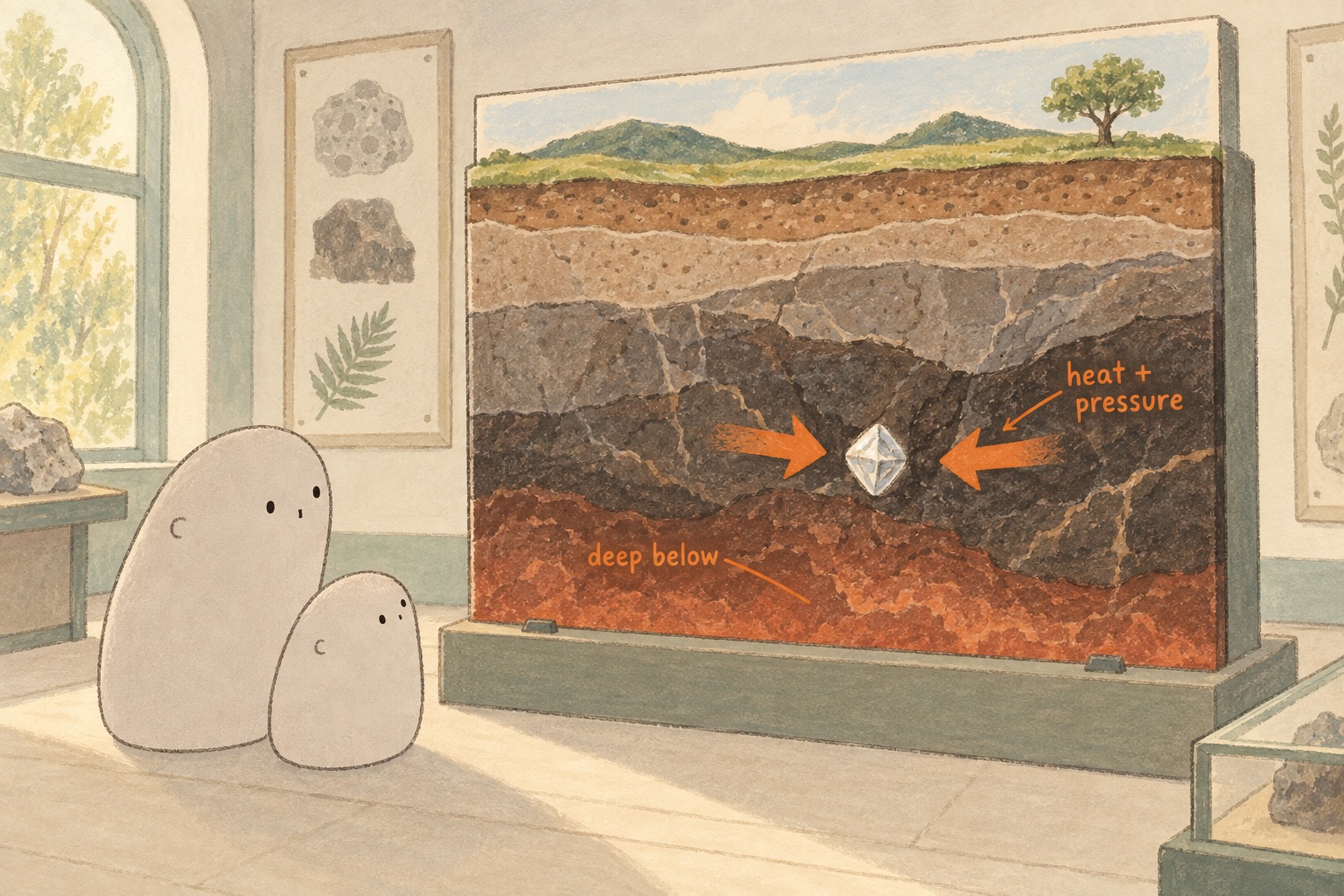
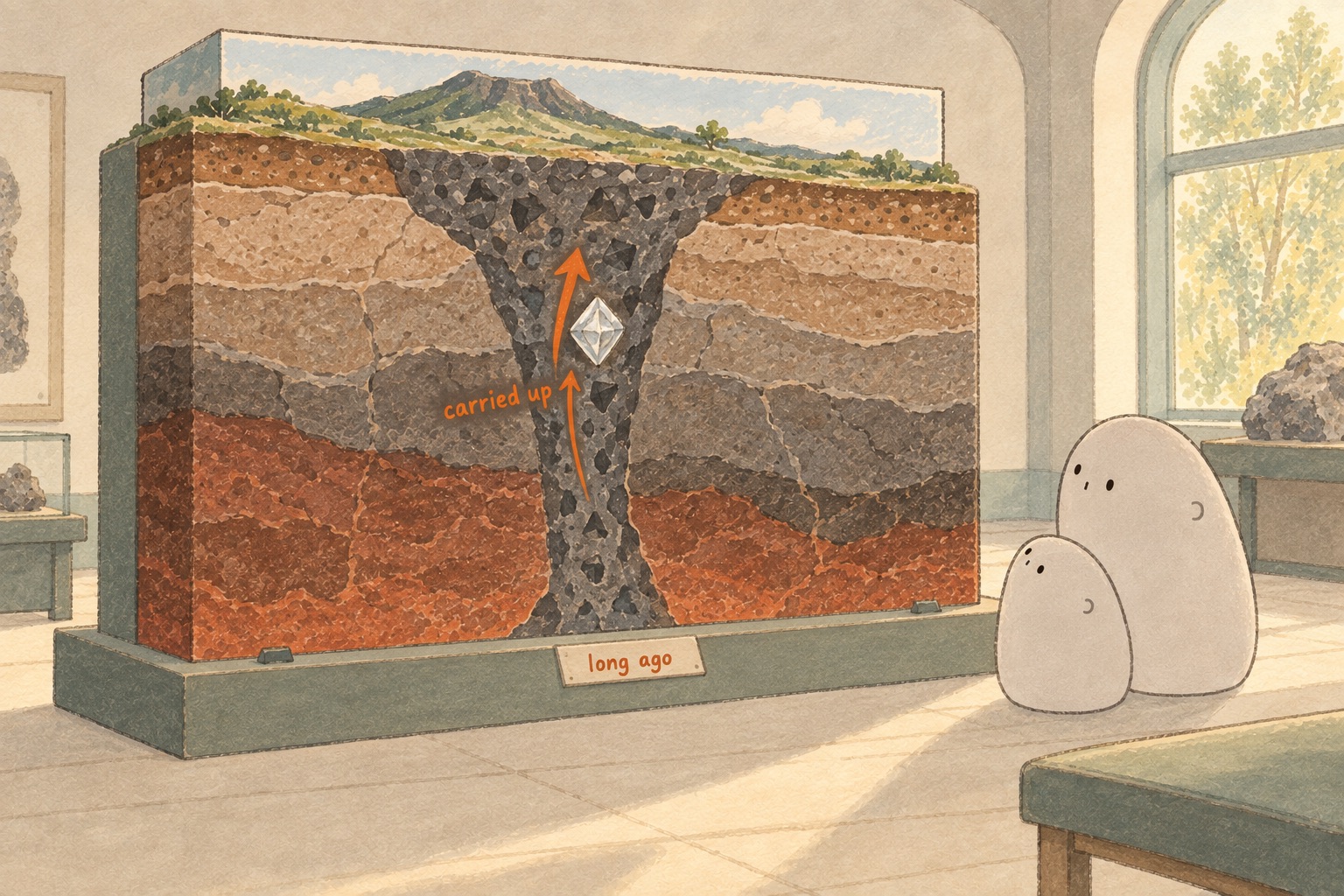
Find the tiny landscape, the crystal, and the two orange arrows. What looks bright? What looks dark?
A little explanation & something to try
Natural diamonds grew from carbon deep underground, where it was very hot and the pressure was enormous. With no light reaching it, a diamond there could not send a flash to anyone's eyes.
Try this. Cover the crystal in the picture with one finger, then uncover it. Tell your grown-up where you would search next for the flash.
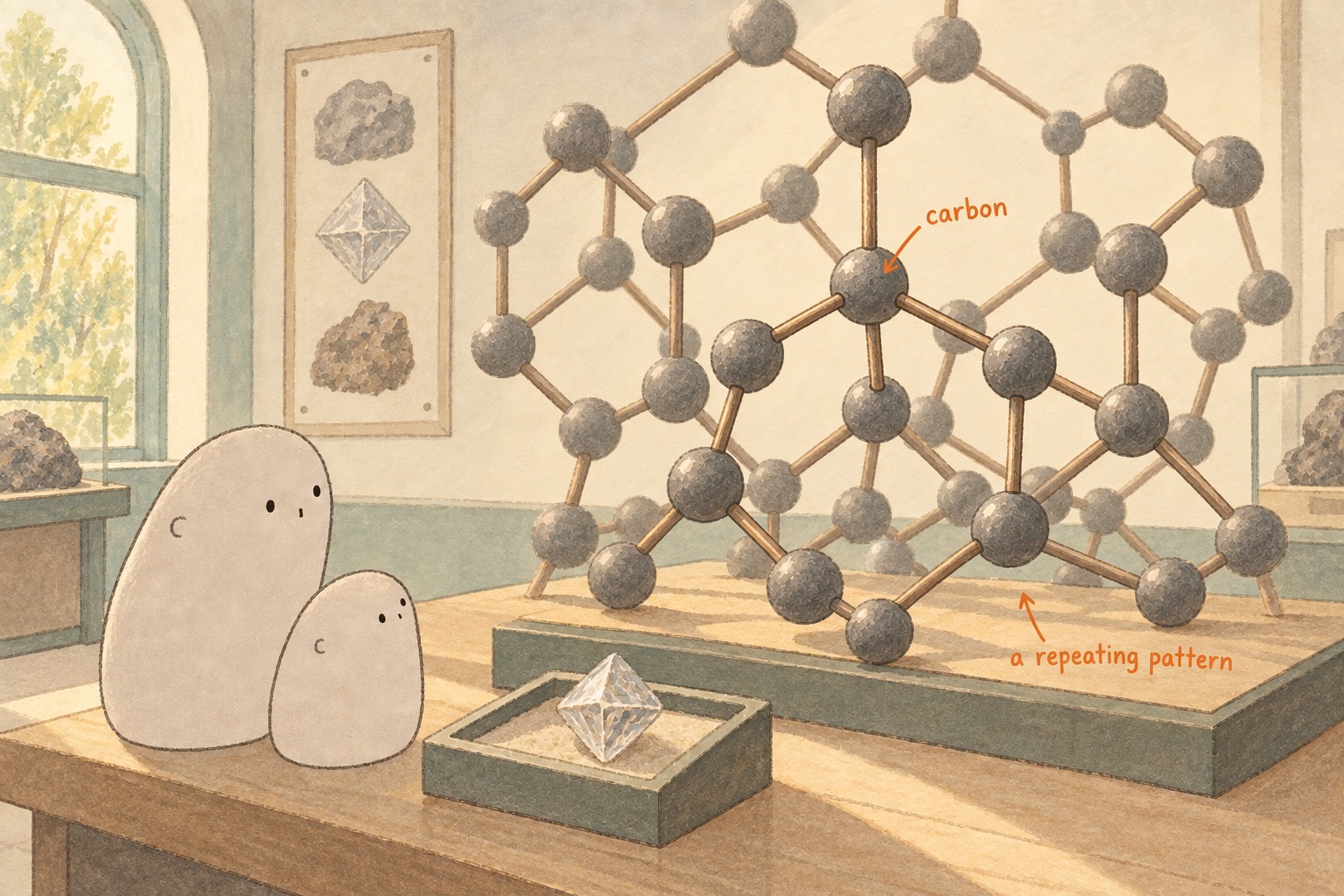
The model reveals a repeating carbon pattern—not a hidden source of light. Real atoms are much too small to see.
Could the diamond's tiny pattern be making the flash?
Look from the small stone to the large model. Follow one rod to the next. Do you see a lamp or another source of light?
A little explanation & something to try
A diamond is made mostly of carbon atoms joined in a repeating pattern. The balls and rods help us picture parts far too small to see, but the pattern is not a hidden lamp.
Try this. Trace three connections with your finger. Say what this model explains—and what it still does not explain.
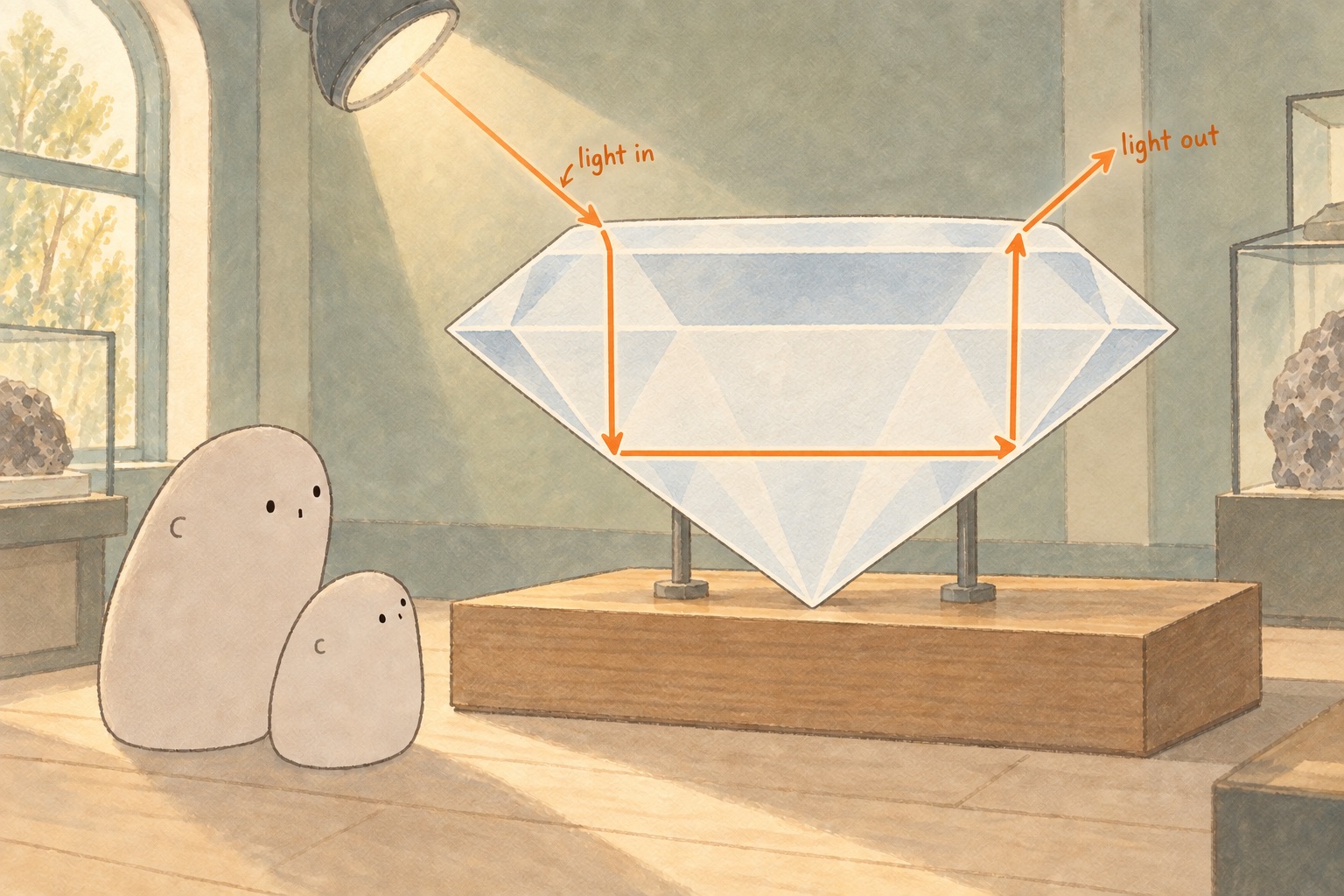
Cut facets change the light's direction and send some of it back out.
Which thing in this picture starts the bright path?
Begin at the orange line. Follow it backward until you cannot go any farther. Where did you land?
A little explanation & something to try
The path begins at the lamp. Light bends when it enters the diamond and can bounce inside. Carefully cut facets help send some of that borrowed light back toward our eyes.
Try this. Trace the whole path from lamp to diamond to eye. Imagine the lamp switched off. What part of the path would disappear?
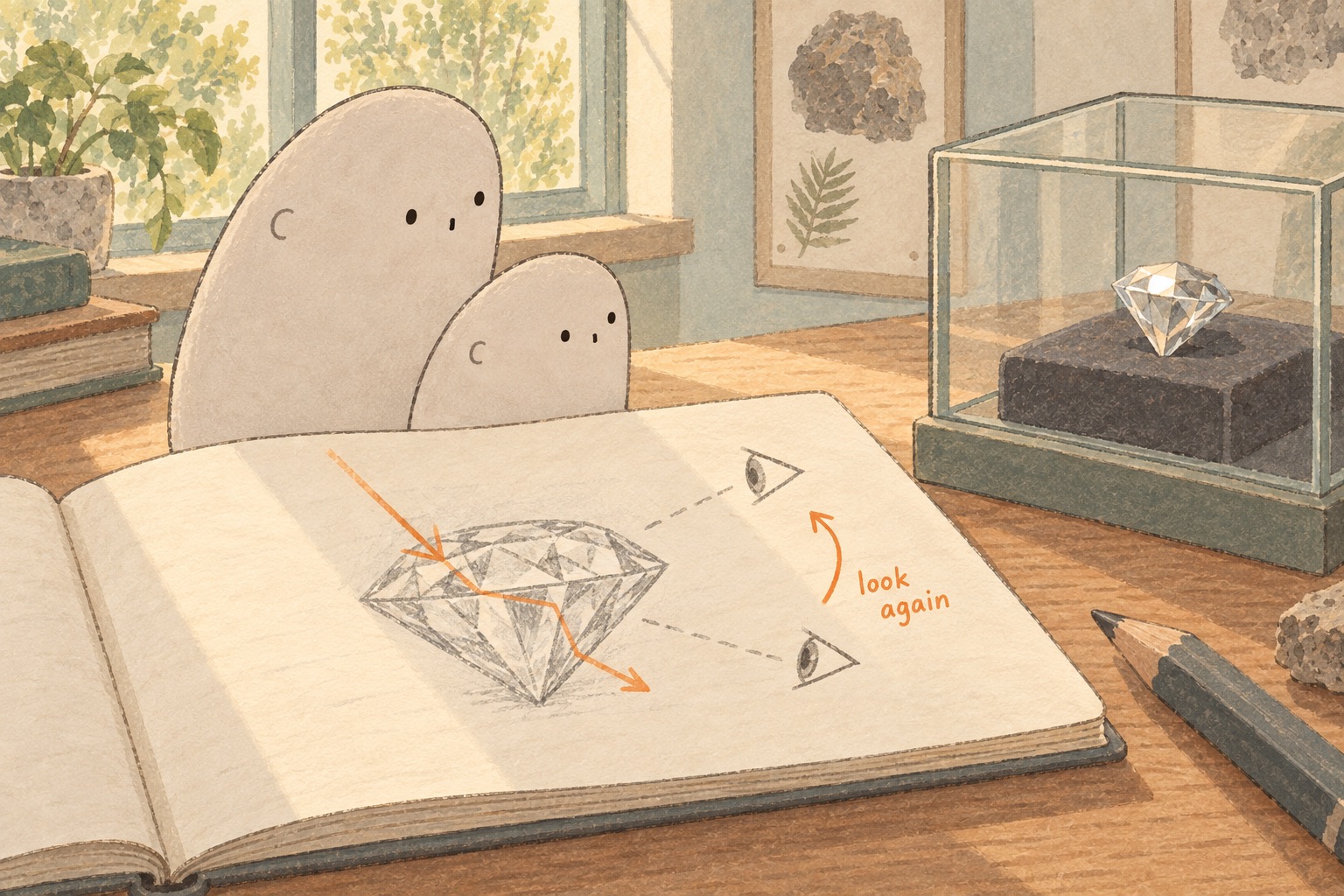
Little's two viewing spots turn a quick flash into an observation they can keep.
Why might the flash move when Little moves?
Find the two eye positions in the sketch. Follow each line toward the drawn diamond. What changed?
A little explanation & something to try
A flash reaches our eyes only along certain paths. When the light, diamond, or viewer moves, a bright facet can dim while another one flashes.
Try this. Point to one eye position, then the other. Pretend you are Little and tell where you would look next.
The flash that wouldn't stay
The flash that wouldn't stay.
No sun down here
A flash winks from a museum case. “The diamond makes light!” says Little Wonderer. Big points to its deep beginning. Heat and huge pressure helped carbon grow into a crystal far underground—without lamp or sun. “Then where does the flash come from?”
What did Little guess? What clue makes that guess wobble?
A pattern, not a lantern
“Maybe light hides in the tiny parts,” Little says. Balls and rods stand for carbon atoms and their connections. The pattern repeats through a diamond—but it is no lantern. “We found the stone,” says Big, “not the flash.”
Follow the pattern. What question is still chasing them?
The long way to daylight
Little traces an arrow up. “To meet light, it had to leave the dark!” Long after some diamonds formed, volcanic eruptions carried them toward the surface. “Now it can meet light,” says Little. Big nods. “But meeting light is not making it.”
Why did Little need the diamond to reach the surface?
The strong-stone surprise
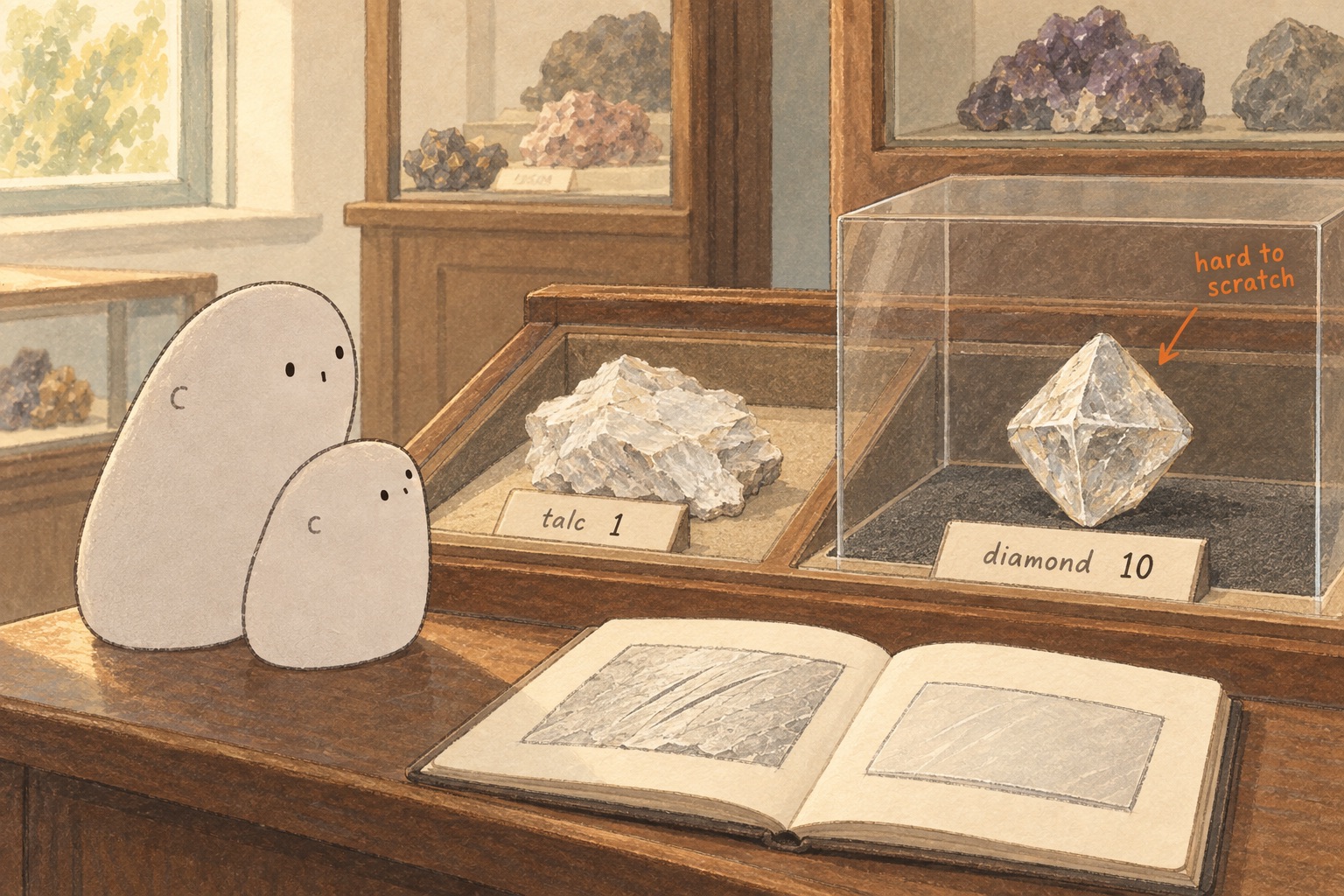
A label marked 10 stops Little. Diamond tops the Mohs scratch scale. “So nothing can hurt it?” Big explains that a diamond can still chip or break. “Hard to scratch is not unbreakable,” Little says, “and it still doesn't explain the flash.”
How did the number 10 almost pull Little off the trail?
A borrowed beam
At the last model, a lamp clicks on. “There!” Little cries. Light enters the diamond, bends, bounces, and comes out again. Cut, flat faces called facets guide its path. Little follows the line. “The diamond sends borrowed light back!”
Trace the beam. Where does the flash truly begin?
The flash that won't stay
Little shifts. One bright face dims; another flashes. “Found you!” The flash was not stored in the stone. It happens when light, cut facets, and watching eyes meet along the right paths. Little sketches both spots, leaving room for a new question.
Move your finger between the two eye spots. What changed?