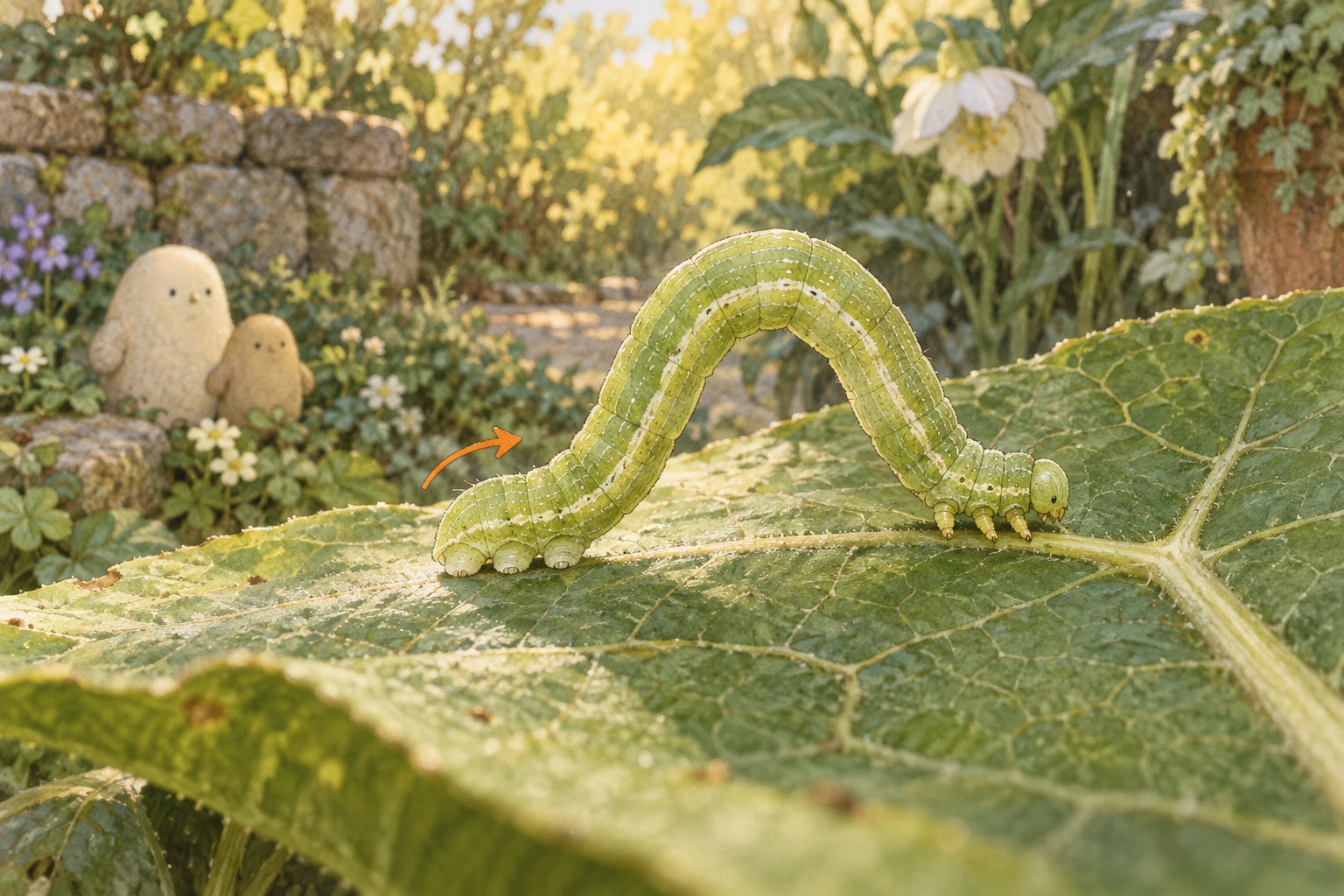
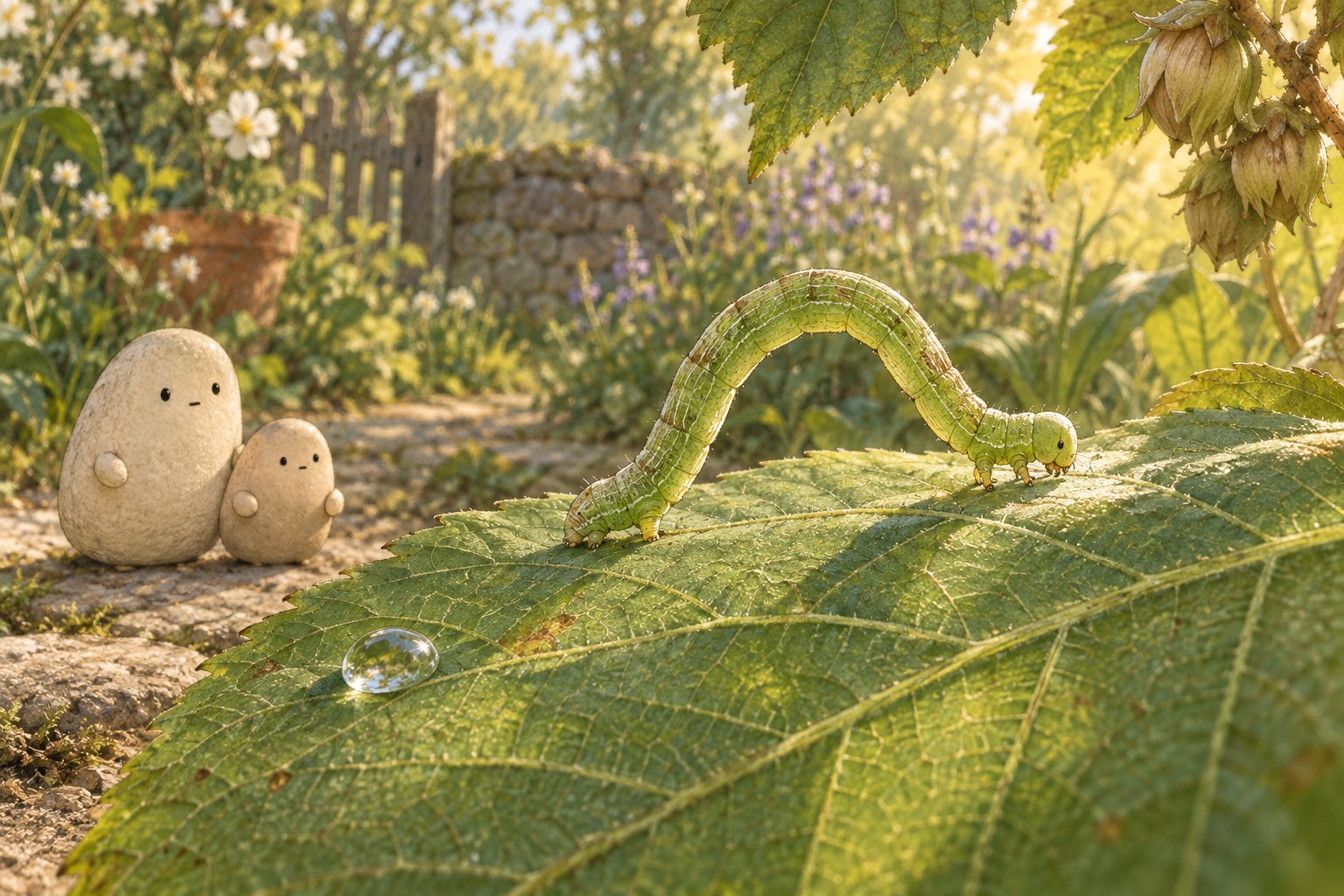
Front grips; rear comes closer. Notice the long legless middle rather than counting the partly hidden feet.
Why does the middle rise into a loop?
Find the head at the right. Follow the body back to the rear feet. Where is there empty space underneath?
A little explanation & something to try
The front legs hold the leaf while the rear comes closer. The long middle bends upward into a loop. Inchworms have jointed legs near the head and fleshy gripping parts called prolegs near the rear, with a long gap between. They do not walk on a row of legs along that middle.
Try this. Draw a long curved line with its two ends close together. Imagine the front end stays in one place as the rear comes closer. Which part must bend?
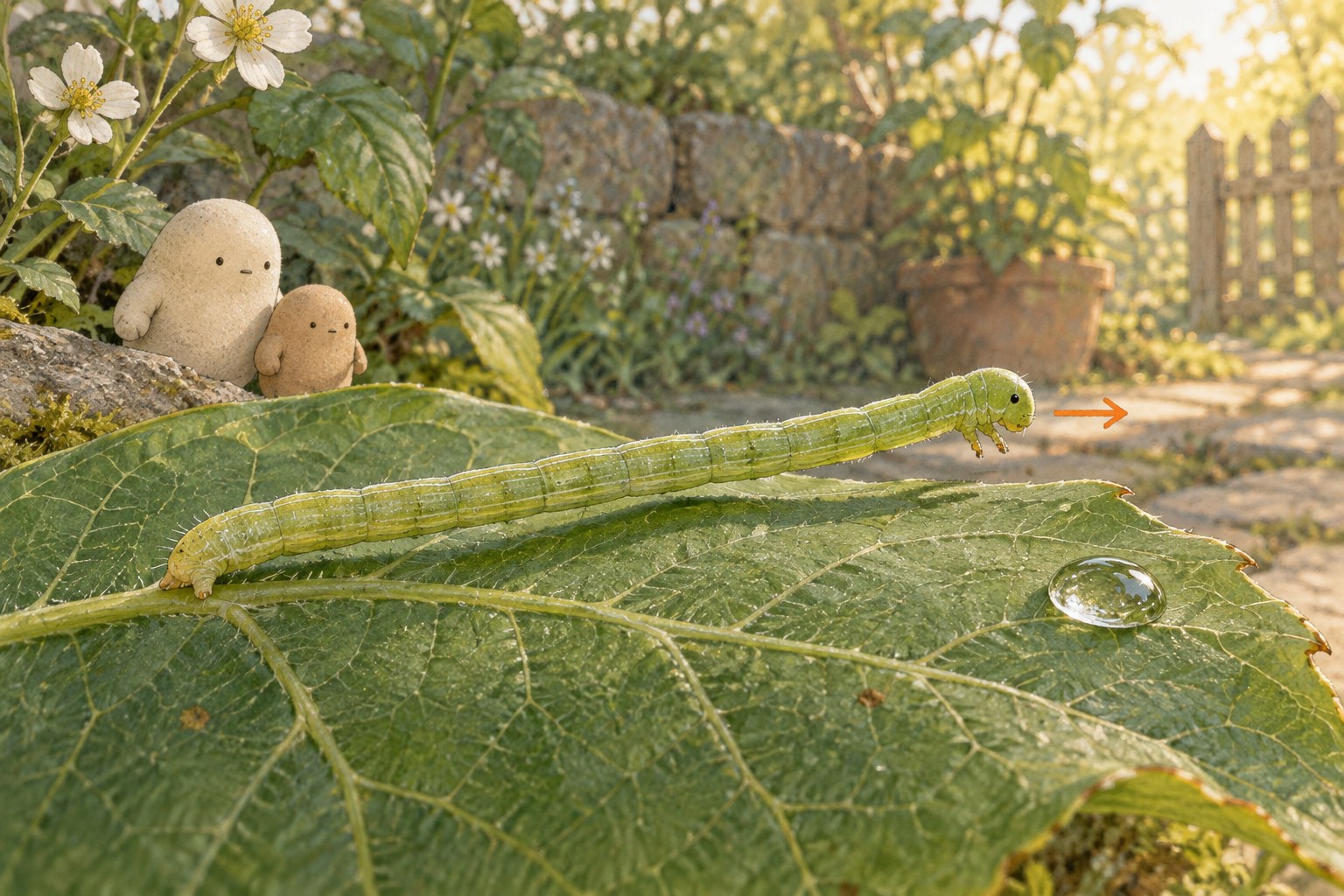
Rear grips; front reaches.
What holds on while the head reaches?
The front is lifted. Follow the body to the far left. Which feet still touch the leaf?
A little explanation & something to try
Now the rear prolegs anchor the body: they hold it in place. The front reaches ahead as the middle straightens. When the front legs grip again, the rear can catch up. The two ends take turns holding on. That repeating sequence carries the caterpillar across a leaf.
Try this. Look at the rear grip. What might happen if it slipped while the front was still reaching? Use a detail from the picture to explain.
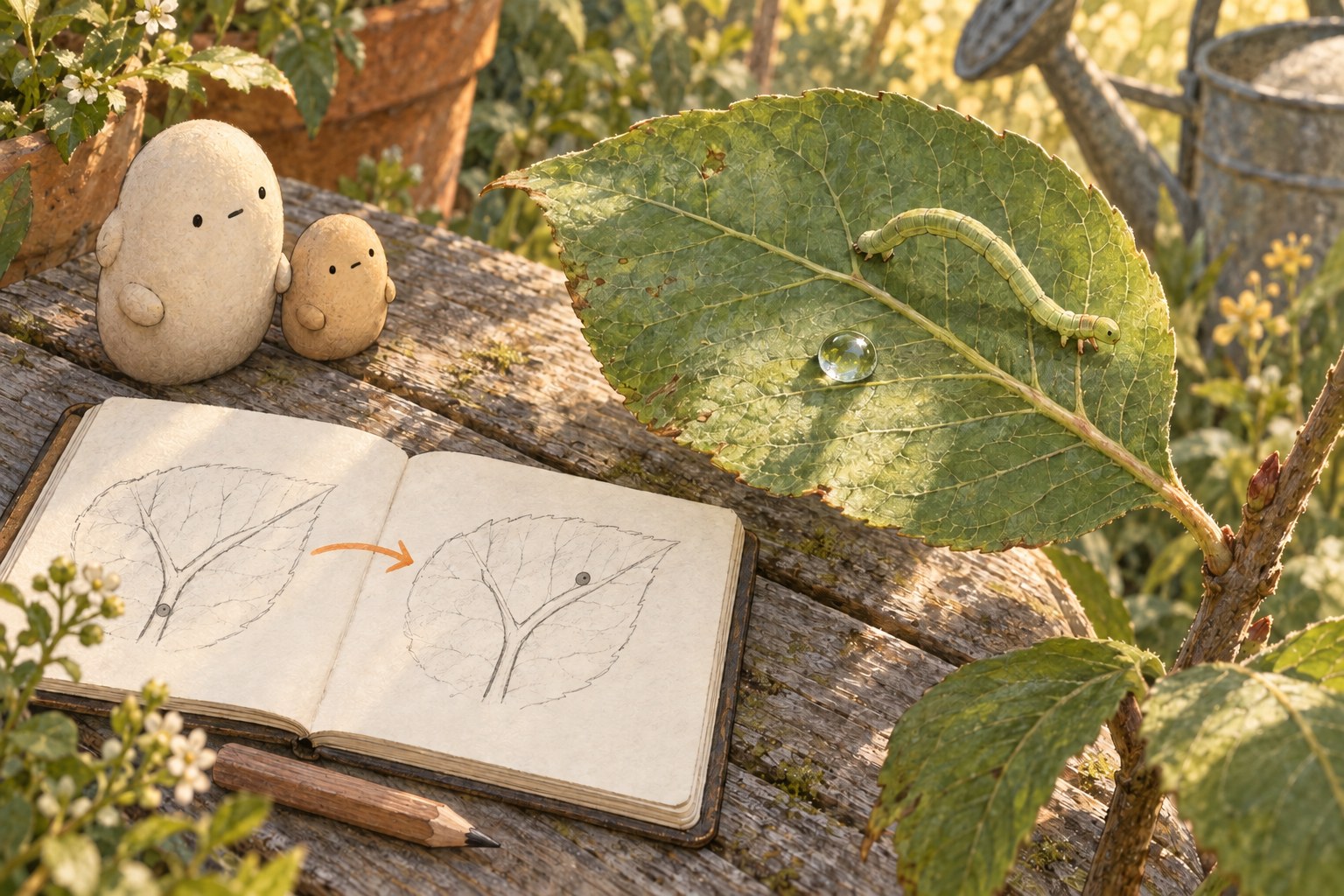
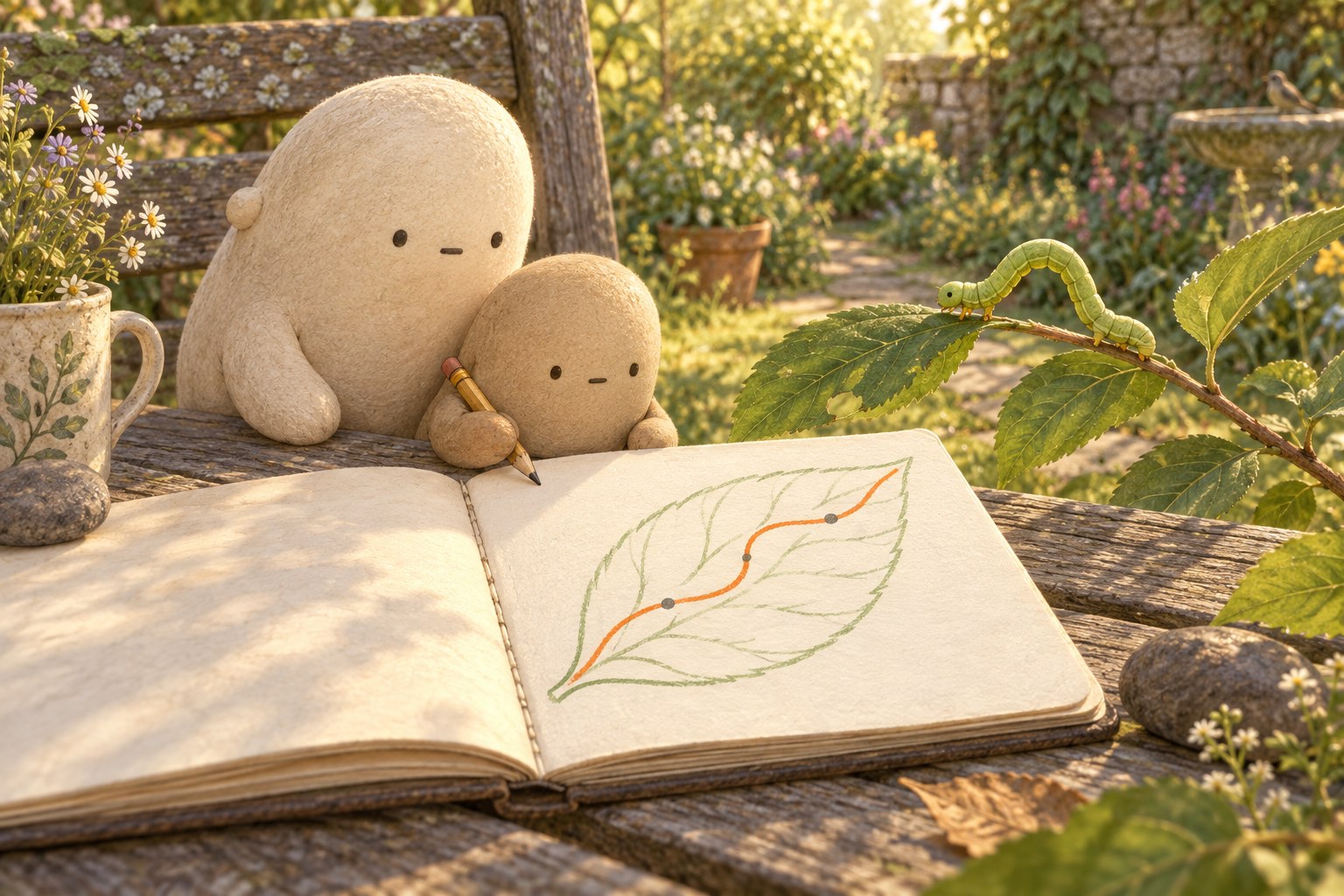
Compare the head marks against the same fork.
How could a leaf vein show it moved?
Compare the two leaf sketches. Each dot records the head. Find the same Y-shaped vein fork in both. What changed?
A little explanation & something to try
A bent body alone does not tell us how far the animal traveled. The first head mark is before the fork; the later mark is beyond it. The fork is a reference point, a place to compare positions against. Those changed positions are evidence for movement. They do not tell us its speed without times.
Try this. Draw a Y and put a dot before it. Draw the same Y again with a dot beyond it. Explain how the two drawings support the idea that the head moved.
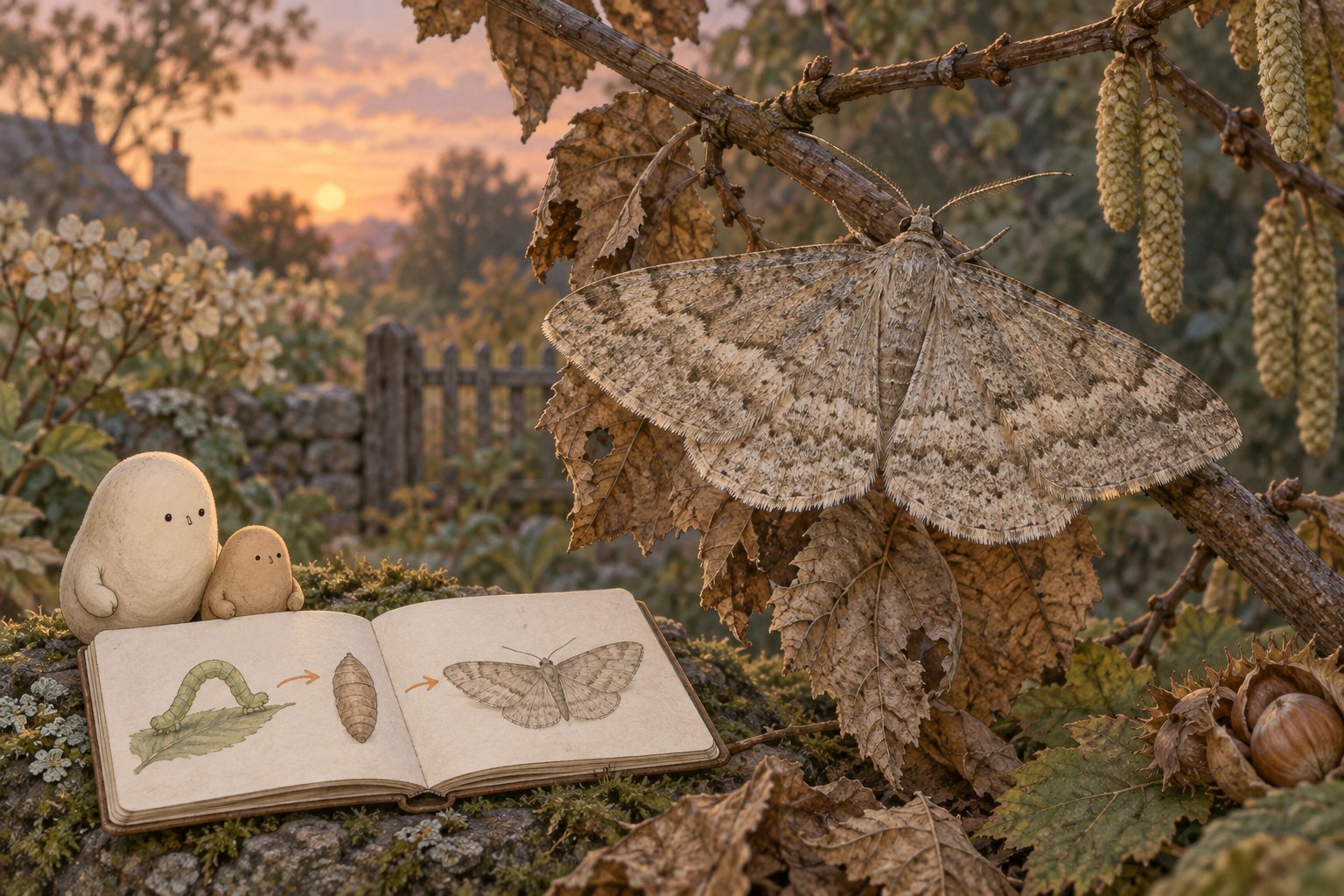
Will this caterpillar always crawl?
Find three life stages in the notebook. How does the last shape differ from the first?
A little explanation & something to try
An inchworm is a caterpillar, the young stage of a geometer moth. It grows, becomes a pupa, then changes into a moth. This big change in body form is metamorphosis. It takes time; this scene imagines a later stage. A moth has six jointed legs. The caterpillar's fleshy prolegs do not remain.
Try this. Follow the notebook arrows: caterpillar, pupa, moth. Name one body feature that changes. What extra observation would help you learn how long the change takes?
A loop goes somewhere
A loop goes somewhere.
The arch begins
Little spots a green arch on the leaf. “A tiny bridge!” The arch flattens, and a small head reaches past a vein. Big watches from the path. Bending is how this caterpillar starts a trip across the same leaf vein.
Which parts are touching the leaf right now?
The rear catches up
Front grips hold the leaf. The rear slides closer and the long middle lifts into a tall loop. Soft grips near the rear are prolegs — fleshy holders, not jointed walking legs. “No walking legs under that middle,” Little says.
Which end stays put while the loop rises?
Hold, then reach
The prolegs anchor the rear: they hold it in place. The front stretches ahead as the body straightens. When the front grips again, the rear can follow. One end holds; the other moves. Loop by loop, the leaf gets shorter.
What might go wrong if the rear slipped mid-reach?
A clue on the leaf
Little draws the head before a vein fork, then after it on the same leaf vein. The two marks are evidence — clues that can support an idea. “It passed the fork!” That idea is an inference: an idea drawn from evidence.
Why is a moved head a stronger clue than a bent body alone?
A pretend leaf route
“Does every loop go one inch?” Little asks. The name sounds like a ruler, but real steps vary. So Little invents a pretend route with made-up distances. A model can answer a math question without turning the picture into a measuring stick.
What would you need to measure a real leaf trip?
A later shape
Little imagines later chapters. The caterpillar becomes a pupa, then a moth. That change of body form is metamorphosis, and it takes time. “A new shape after all those loops,” Little grins.
For a complete still story, download the foldable book.
How much leaf is left?
Imagine a 32-millimeter route on a leaf. An inchworm walks 12 mm, then 9 mm. A millimeter is a tiny length unit; mm is the short name. Use the table. Show your thinking.
Journey distances · Millimeters
Part
Whole route
First stretch
Next stretch
Length (mm)
32
12
9
Keep using mm. Show each step.
1. Walk 12 mm, then 9 mm. How far in all?
12 + 9 =
A small hint
Add 12 and 9. You can make a ten first if that helps.
2. Route is 32 mm. After 12 mm and 9 mm, how much is left? Show both steps.
32 − (12 + 9) =
A small hint
First add 12 and 9. Then take that sum away from 32.
3. Add 8 mm to the 32 mm route. After a 21 mm walk, how much is left?
(32 + 8) − 21 =
A small hint
Make the new whole first (32 + 8). Then subtract 21.
4. A trip goes 7 mm, then 6 mm, then 5 mm. How far in all?
7 + 6 + 5 =
A small hint
Add any two first, then add the last number.
5. Trip A: 12+9 mm. Trip B: 7+6+5 mm. Which is longer, and by how much?
(12 + 9) − (7 + 6 + 5) =
A small hint
Find each total. Subtract the smaller total from the bigger one.
6. 11 mm left. Two friends share it as evenly as they can. How much each, and how much left over?
11 ÷ 2 =
A small hint
How many groups of 2 fit in 11? What is left?
Explain a tiny grip.
Choose a scene. Write two linked sentences: one observation, then an explanation using because. Draw a detail that supports your idea.
Front grips; rear comes closer. Notice the long legless middle rather than counting the partly hidden feet.
The middle rises because …What happens when the rear gets closer to the gripping front?
Rear grips; front reaches.
The rear grip matters because …What keeps the body in place while the front reaches?
Compare the head marks against the same fork.
I infer that it moved because …Compare the head with the same vein fork in both sketches.
Draw the detail you noticed. Add an arrow to show movement or a dot to show position.
SAY IT FIRST. THEN DRAW OR WRITE.
A temporary space. Copy your words before closing or reloading; they are not saved or sent.
prolegsanchorloopreachevidenceinferencebecause
Reread your words. Does the detail support your explanation? Check the first capital and each ending mark.